In briefFreeze the rules, preserve the data and its timestamps, separate development from untouched testing, and report costs and unresolved execution assumptions alongside the result.
Define the question and freeze the rules
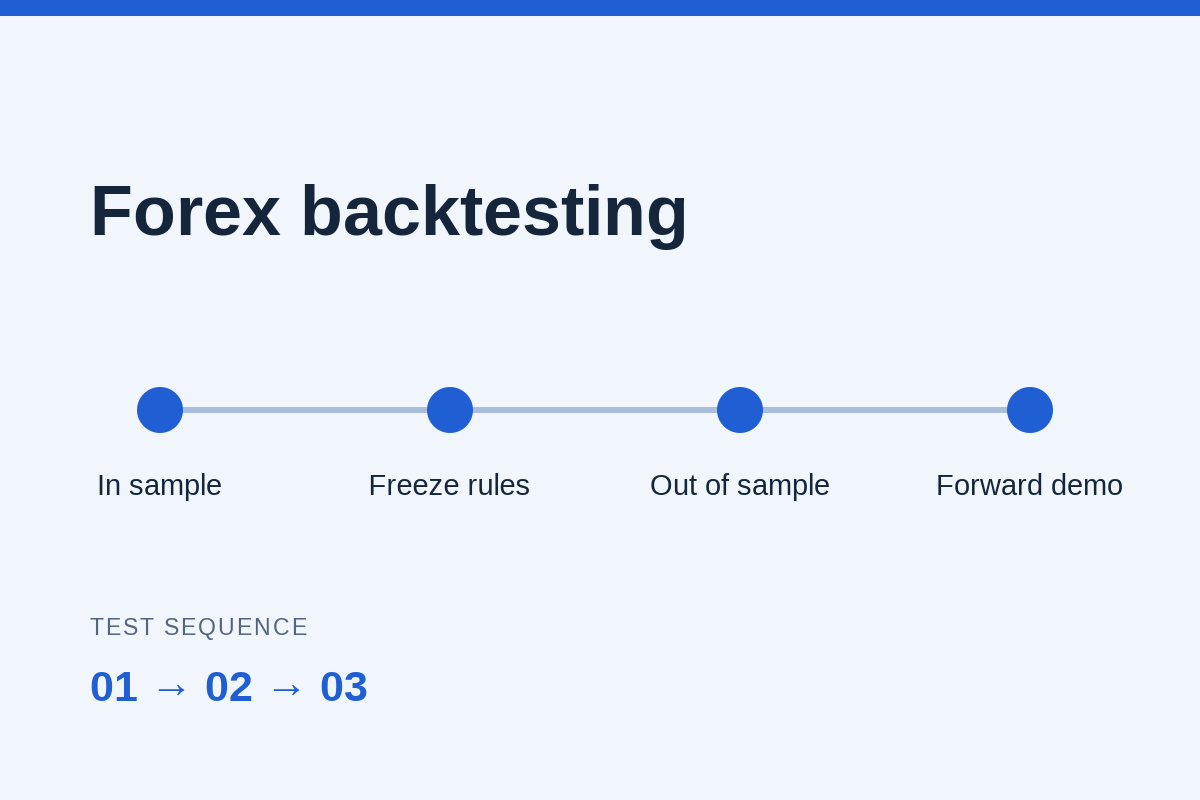
Forex backtesting means applying predefined trading rules to historical data to examine what those rules would have produced under stated assumptions. A reproducible manual test starts by freezing the rules, fixing the data and timestamps, separating calibration from out-of-sample and forward simulated testing, and accounting for costs. Its result is conditional evidence about that specification, not proof of future performance.
Begin with a written test question rather than a target profit. For example, an invented research question might ask whether an already defined rule set remains internally consistent when applied to an untouched historical period with costs included. That question establishes what the exercise can answer. It does not require inventing a strategy or treating a positive total as the only useful outcome.
Create a versioned rule sheet before opening the first test chart. Specify the instrument, chart interval, permitted decision times, required inputs, entry and exit conditions, position-sizing convention and treatment of overlapping signals. State how missing information and ambiguous candles will be handled. These are proposed controls for making the exercise repeatable; they are not claims about any particular platform's defaults.
Write conditions so another reader could reach the same decision from the same information. Phrases such as 'a clear move' or 'a reasonable exit' leave discretion hidden inside the result. If a condition cannot be applied without judgement, describe that judgement explicitly and record its use. Date the frozen document and give it a version identifier before proceeding.
Fix the data, timestamps and observation method
A rule sheet is only half the specification. Preserve a data manifest containing the source, instrument identifier, historical range, chart interval, timezone and date of retrieval. Retain the actual dataset or a stable copy where possible. A later test using a changed historical series is not an exact repetition, even when the chart label and rule version appear unchanged.
Decide what each timestamp represents before reviewing signals. A candle labelled 10:00 might need to be interpreted as an opening time or a closing time, depending on the dataset. Establish that interpretation from the data information rather than guessing. Record how any timezone or clock changes are handled so that a time-based condition always refers to the same convention.
Check a small sample of records manually before committing to the full exercise. Look for duplicate timestamps, gaps, inconsistent ordering and unexplained changes in the recorded interval. Record what you find and how you handle it. Do not silently fill gaps or remove inconvenient observations: those interventions change the evidence and should be visible in the manifest.
Keep platform selection separate from validation of the test. When you move a strategy from MetaTrader 5 to cTrader, compare the historical price series, fill assumptions and cost inputs before looking at the performance figures. A difference in the result might come from the tester settings rather than the strategy.
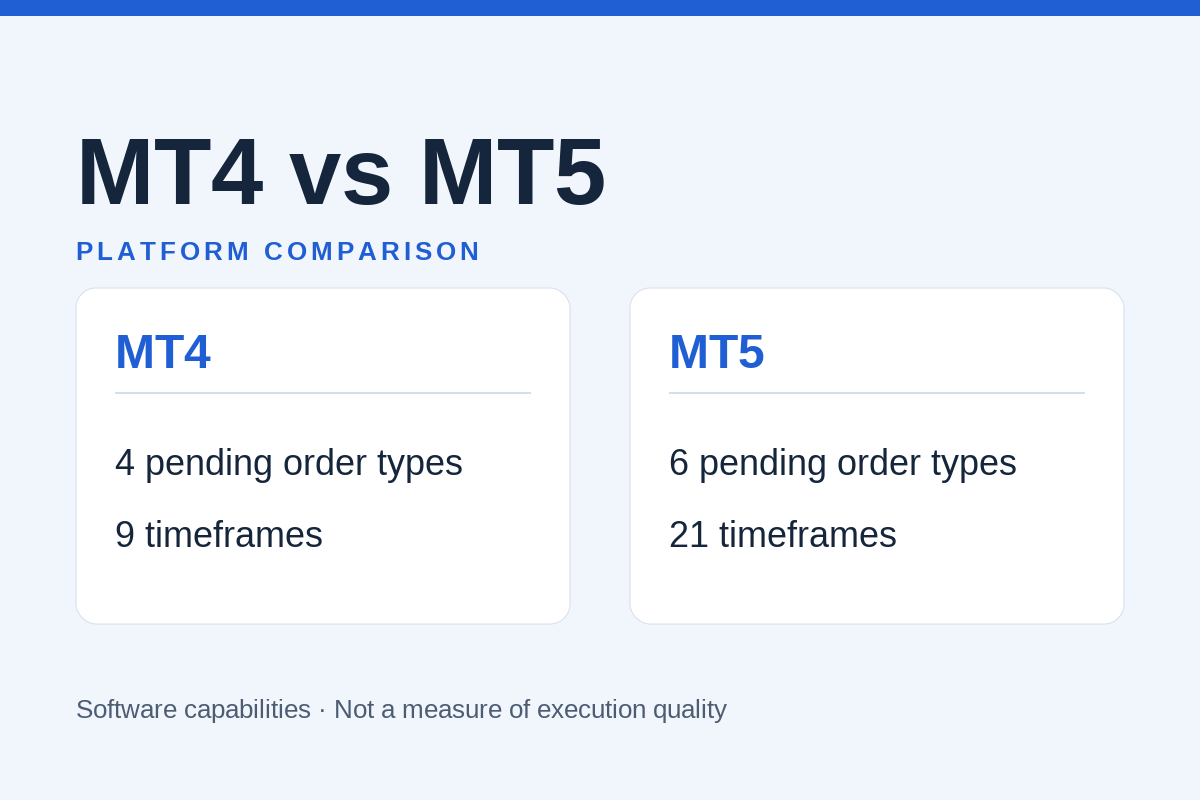
For a platform-selection starting point, use the MT4 versus MT5 comparison, then verify the exact data and timestamp conventions used in your own test.
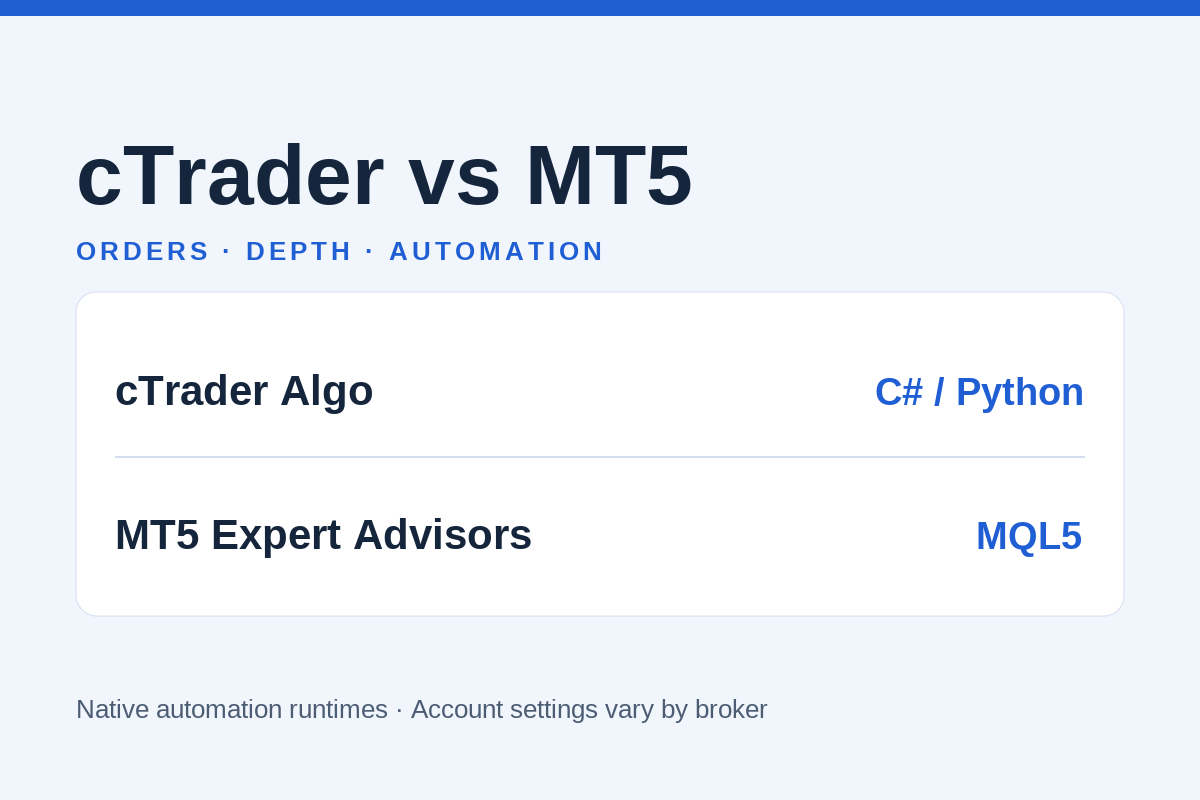
If comparing a different pair of environments, the cTrader versus MT5 guideprovides a separate reading route; keep your test specification independent of the platform label.
Separate calibration, out-of-sample and forward simulation
Assign each period a purpose before examining its outcome. Calibration is the development stage, where rules or assumptions may be revised. Out-of-sample testing applies the frozen version to historical observations reserved from that development. A forward simulated test then records decisions as new observations arrive, without placing real-money trades. These stages answer different questions and should not be merged into one headline result.
The boundary matters more than the label. If you inspect an out-of-sample outcome and alter a condition because of it, that period has influenced development. Record the change as a new version rather than continuing to describe the same period as untouched. A renamed file or a fresh spreadsheet does not restore the original separation.
For an invented scheduling example, reserve one historical block for calibration and a later block for out-of-sample testing, then specify when forward simulation will begin. Write the actual boundaries in the test plan before reviewing the reserved block. No particular split length is prescribed here: the practical requirement is that the allocation and subsequent changes remain auditable.
Keep separate summaries for each stage, even if a combined ledger is convenient for administration. This allows a reader to distinguish development observations from evidence collected after the rules were fixed. If you run several versions, retain their identities and explain which observations each version has already encountered.
| Stage | Permitted use | Record to retain |
|---|---|---|
| Calibration | Develop and revise the specification | Version history and reasons for changes |
| Out-of-sample | Apply the frozen specification to reserved history | Untouched-period boundaries and decision ledger |
| Forward simulated | Apply the specification as new observations arrive | Timestamped simulated decisions and assumptions |
Three test stages with different permissions
Replay decisions without borrowing future information
Look-ahead occurs when a historical decision uses information that would not yet have been available at its stated decision time. In a manual review, the danger is practical: the completed chart may reveal the next candle, the eventual session high or the outcome of an open position. Hide later observations and advance through the record in the agreed sequence.
Distinguish the time an observation describes from the time it becomes available to the rule. If a condition requires a completed candle, its final high, low and close cannot be treated as known earlier within that candle. Record both the observation used and the decision timestamp. This makes a timing error easier to identify than a single unexplained entry mark.
Use a decision ledger, including occasions when the rules require no action. For each reviewed point, record the rule version, information available, condition assessment, simulated action and any exception. Logging only completed trades removes evidence about skipped signals and discretionary exclusions. A short reason such as 'condition not met' is useful when it identifies the relevant written condition.
The following invented replay sequence illustrates the discipline, not a trading method. Its purpose is to prevent knowledge of the outcome from changing a historical decision. If a mistake is discovered later, preserve the original entry, identify the correction and explain whether it changes the test's interpretation.
One decision point in a manual replay
Reveal data only through the completed candle being assessed; keep later candles hidden.
Use the identified rule version and write down whether each required condition is met.
Timestamp the simulated decision, note assumptions, then reveal the next observation.
Show the cost bridge from gross to net
Report the result before costs separately from the result after the costs included in your model. Identify spread, commissions and financing explicitly, and state how each is assigned to the simulated transactions. If a cost cannot be established from the available evidence, label it as an assumption or an unresolved input rather than quietly treating it as zero.
The arithmetic below is entirely invented. A gross gain of $120, less $75 for spread and commissions and $25 for financing, leaves $20. The example demonstrates subtraction only. It is not a return, a broker quotation, a prediction or evidence that any rule set is profitable. The currency is simply the unit used in this hypothetical ledger.
Check that costs are counted once. For example, if the simulated entry and exit prices already incorporate a spread assumption, subtracting the same spread again would duplicate it. Conversely, a gross calculation that excludes transaction costs needs an explicit adjustment. Document the chosen convention beside the ledger so that a reviewer can reproduce the bridge.
Treat slippage as an execution assumption distinct from a conveniently chosen closing price. State whether and how your test represents a difference between the intended price and simulated execution. If the evidence cannot support a particular value, avoid presenting one as observed. You can identify the unresolved exposure without claiming to know its magnitude.
To examine the execution concept separately, read the guide to forex slippage and keep any resulting test assumption clearly labelled.
An invented gross-to-net calculation
Subtracting $75 leaves $45; subtracting the remaining $25 leaves $20.
Do not invent an order inside a candle
Bar-only data cannot establish every sequence of prices within a candle. Its open, high, low and close describe selected features of the interval, not the complete path between them. When both a stop and a target lie within that candle's recorded range, those values alone cannot tell you which level was reached first.
Consider an invented position that was already open before a candle began. Its stop is 1.0980 and its target is 1.1040; the next candle records a low of 1.0970 and a high of 1.1050. Both levels fall within the range. Without suitable evidence of the intervening sequence, assigning the target first would manufacture information the bar does not contain.
Choose an ambiguity policy before replaying the data. You might flag the case as unresolved, report separate stop-first and target-first scenarios, or seek suitable finer-grained evidence. Each choice needs to remain visible in the results. An assumed ordering is a modelling convention, not a recovered historical fact, and finer data should still be checked for what it actually resolves.
Count and list ambiguous cases rather than burying them in the total. If a conclusion changes when the assumed order changes, report that dependence directly. The useful finding may be that the available data cannot answer the test question reliably, rather than that either favourable or unfavourable ordering is the correct historical account.
Review the evidence and preserve a repeatable record
Finish with a report that another person could reconstruct: frozen rules, data manifest, period boundaries, decision ledger, cost conventions, ambiguity policy and a list of corrections. Reconcile the ledger to each stage's summary. Check that every included transaction follows the stated rules and that every exclusion has a recorded explanation rather than a retrospective justification.
Do not reduce the review to the final net amount. Examine the path of cumulative simulated results, including drawdown, alongside the cost bridge and unresolved cases. State which assumptions the conclusion depends on. A positive ending does not repair look-ahead, missing costs or an unrecorded rule change; those are defects in the evidence itself.
Carry the same specification into forward simulation and log decisions before their outcomes are known. This extends the audit trail but does not turn simulation into live execution evidence. Keep any later revisions versioned, preserve the earlier record and separate what was observed from what remains assumed.
For context on reviewing the path rather than just the endpoint, see what drawdown means in forex. Keep its measurement convention explicit in your report.
Before interpreting forward simulated observations, review demo versus live trading accounts and avoid treating the two settings as equivalent evidence.