In briefMeasure buys against the reference ask and sells against the reference bid. Positive signed adverse slippage means a worse fill; negative means a better fill. Keep the reference time, quote side and actual fill together.
What forex slippage measures
Forex slippage is the difference between a reference price and the price at which an order actually fills. To measure it consistently, compare a buy fill with the reference ask and a sell fill with the reference bid. Under the signed adverse-slippage convention used here, a positive result means the fill was worse than the reference, a negative result means it was better, and zero means they matched.
The word reference matters. A quote observed when an order is submitted and a quote captured earlier are not interchangeable benchmarks. If a log simply says “expected price”, it leaves an important question unanswered: expected according to which quote, on which side, and at what time? Record those details before interpreting the difference as evidence about execution.
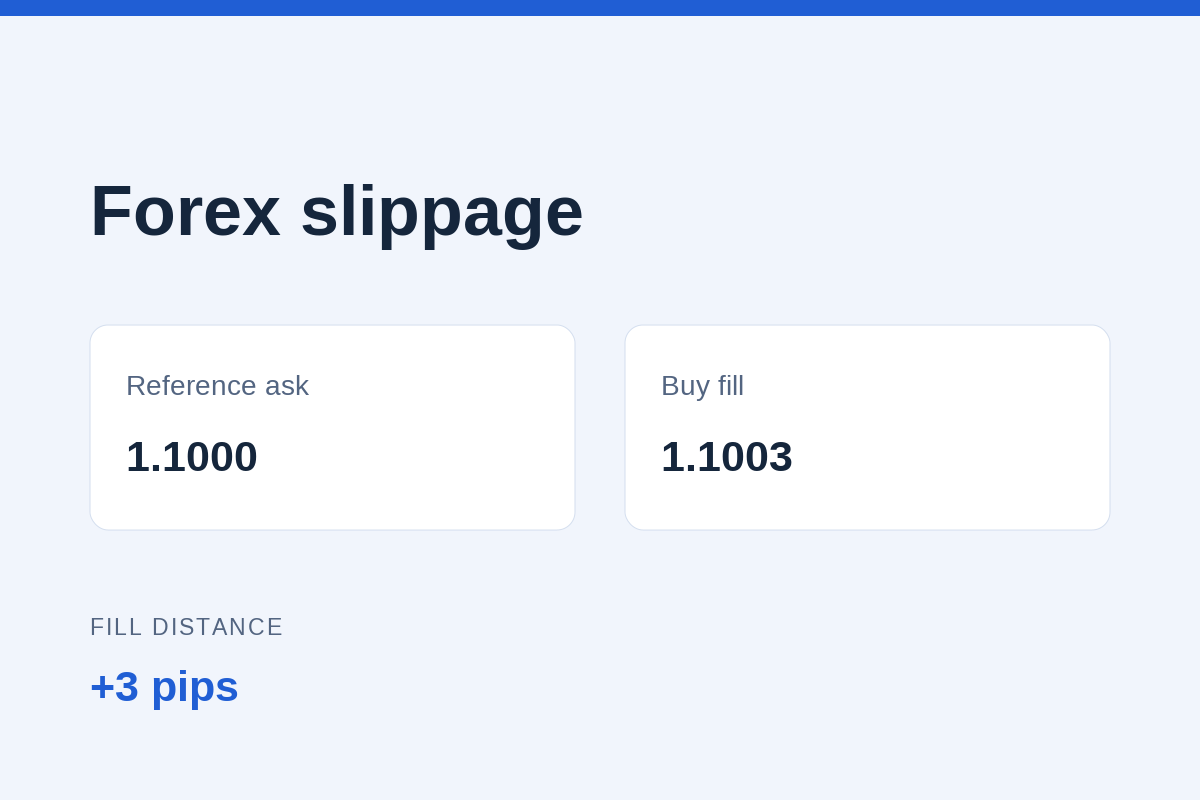
For example, suppose a hypothetical EUR/USD buy has a reference ask of 1.1000 and fills at 1.1003. The fill is above the ask used as the benchmark, so the difference is adverse for the buyer. A hypothetical sell needs the opposite subtraction: its reference bid minus its fill. Applying the buy calculation to both directions would reverse the meaning of the sell result.
This is a measurement convention, not an explanation of why a particular fill occurred. A quote-to-fill difference establishes the gap against the chosen reference. By itself, it does not establish its cause or show whether an order was handled according to its governing terms.
Calculate the signed gap before its cash equivalent
Start with the price difference, then express it in pips. In the EUR/USD example, 1.1003 minus 1.1000 equals 0.0003, or 3 pips using a pip size of 0.0001. Keeping the price calculation visible makes the result easier to audit than recording only a cash amount, which also depends on the pip-value assumption.
At an assumed value of $10 per pip, that 3-pip adverse difference is $30. The assumption is part of the example, not a statement that every EUR/USD position has that pip value. Write it beside the cash calculation so that another reader can distinguish the measured execution gap from the conversion used to express it in money.
For a separate hypothetical sell, take a reference bid of 1.1000 and a fill of 1.1002. The calculation is 1.1000 minus 1.1002, giving −0.0002, or −2 pips. The negative sign means a better fill against that reference. At the same assumed $10 per pip, the signed cash equivalent would be −$20.
Do not remove the signs when comparing entries. Turning every result into a positive distance would make a better fill look like an adverse one. A useful practical check is to read the trade direction aloud: a higher fill is worse for a buy, while a lower fill is worse for a sell.
Keep the execution calculation separate from the monetary conversion. The pip-value tool provides a related reference point; any cash example still needs its pip-value assumption stated explicitly.
Signed adverse slippage
The $30 adverse cash equivalent uses an assumed $10 per pip.
Keep spread and slippage as different measurements
Spread and slippage answer different questions. The spread is the difference between the bid and ask in a quote. Slippage compares the relevant reference side with the eventual fill. Mixing them makes it impossible to tell whether a recorded difference came from comparing opposite quote sides or from a change between reference and execution.
Consider a hypothetical reference quote with a bid of 1.0998 and an ask of 1.1000. Its spread is 0.0002, or 2 pips on the EUR/USD convention used here. If a buy fills at 1.1000, its slippage against that reference ask is zero. Comparing the fill with 1.0998 instead would incorrectly label the quoted spread as buy slippage.
If that buy instead fills at 1.1003, its signed adverse slippage is 3 pips against the reference ask. The reference spread remains 2 pips. These are separate observations with separate comparison points; neither number should silently replace the other in an execution log.
A practical check is to retain both bid and ask whenever possible, even though only one enters the direction-specific slippage calculation. That makes an accidental wrong-side comparison easier to spot. It also preserves the reference spread without requiring someone to reconstruct it later from incomplete notes.
For the quote-side distinction, read what a forex spread is and what it costs. In a slippage record, label the spread separately rather than treating every price difference as one execution charge.
Build a log that preserves the reference
A useful trade log preserves the inputs as well as the answer. Include the currency pair, buy or sell direction, order type, reference bid and ask, reference timestamp, fill price and fill timestamp. Identify what the reference timestamp represents, such as the quote captured at submission, rather than giving an unexplained time alone.
Use a consistent timestamp format and name the time zone. In the hypothetical entry below, the reference is explicitly the submission-time quote. The later fill timestamp identifies a different event; it is not a substitute for the reference time. Keeping both prevents an after-the-event quote from being mistaken for the original benchmark.
Add the calculated signed price difference, pip size, signed pip result and any assumed pip value. Preserve the original inputs when correcting a calculation, so the reason for the correction remains understandable. If the reference side or time is missing, mark that limitation instead of supplying a guessed quote.
The example is deliberately a single fill. It demonstrates an auditable comparison, not a claim about typical execution. Its strength is that someone else can reproduce the 3-pip result from the recorded ask and fill without relying on the writer’s description of the outcome.
| Field | Recorded example |
|---|---|
| Direction and reference event | Buy; quote captured at submission |
| Reference timestamp | 09:00:00.000 UTC |
| Reference bid / ask | 1.0998 / 1.1000 |
| Fill timestamp and price | 09:00:00.200 UTC; 1.1003 |
| Signed adverse slippage | +0.0003; +3 pips |
| Assumed pip value / cash equivalent | $10 per pip / +$30 |
Hypothetical EUR/USD buy log: reference and fill are separate events.
Separate slippage, tolerance and rejection
A completed fill and a rejected order are different outcomes. Slippage requires a fill price to compare with the reference. If an order is rejected, there is no fill price for that attempt, so entering zero slippage would be misleading. Record the rejection as an outcome rather than turning it into an apparently exact execution.
An order tolerance is also not the same thing as realised slippage. Where a tolerance applies under the relevant order rules, it concerns the permitted execution difference or handling of the request. The realised measurement still comes from the actual fill and chosen reference. Check the applicable rules rather than assuming a setting works identically everywhere.
In a hypothetical review, one buy request fills at 1.1003 against a 1.1000 reference ask, while another request is rejected. The first has measurable adverse slippage of 3 pips. The second belongs in the outcome record but has no quote-to-fill slippage result. Keeping them separate avoids making the rejected request appear better executed.
Order labels therefore need context. Record the order type and any relevant tolerance alongside the request outcome, then calculate slippage only where a fill exists. This preserves the difference between what was requested, what conditions applied and what was actually executed.
Use the guide to forex order types to organise order terminology, then check the applicable execution terms for the particular request.
Review the 1.1000 reference-ask buy
Save the 1.1000 reference ask, its timestamp and the order direction.
Record whether the request filled or was rejected; retain applicable tolerance details.
If filled at 1.1003, record +3 pips. If rejected, record no fill and no slippage result.
Do not confuse an ordinary stop with a guarantee
An ordinary stop and a guaranteed stop should not be treated as interchangeable. An ordinary stop is not itself a guarantee of the eventual fill price. Where a guarantee is offered, its meaning and application are subject to the contract. The order label alone is therefore insufficient evidence of what price protection applies.
Keep the stop level separate from the quote reference in your notes. A comparison between a stop level and a fill answers a different question from a comparison between a timestamped reference bid or ask and that fill. Both can be recorded, but they need distinct labels so the benchmark does not change unnoticed.
A price gap is likewise distinct from the slippage calculation. The existence of a gap does not supply a missing reference quote, and a measured adverse difference does not by itself prove that a gap caused it. Record supporting observations separately from the arithmetic.
For a practical contract check, identify whether the stop is ordinary or guaranteed, which terms govern any guarantee and which reference your execution calculation uses. Where the available record cannot establish an explanation, leave that explanation unresolved rather than presenting a plausible account as a documented fact.
Background on liquidity in forex can help frame execution questions, but it does not replace the order record or establish the cause of an individual fill.
Check comparability before drawing conclusions
Before comparing log entries, check that they use the same sign convention and a clearly defined reference event. A buy measured against a submission-time ask is not directly equivalent to one measured against an earlier displayed price. Differences in the measurement method can otherwise masquerade as differences in execution.
Check missing information as carefully as completed calculations. A cash result without a pip-value assumption is incomplete; a pip result without direction and reference side is difficult to verify. Rejected requests must remain distinguishable from fills, and better fills must retain their negative sign under this convention.
Finally, keep description separate from judgement. The defensible conclusion from the worked buy is narrow: a fill at 1.1003 was 3 pips worse than a reference ask of 1.1000, equivalent to $30 at the stated assumption. That result alone does not establish a general execution standard, explain the cause or determine whether contractual obligations were met.
When reading about ECN forex brokers, do not use a category label as a substitute for timestamped execution evidence.
Likewise, comparisons of raw-spread and standard accounts should keep account terminology separate from the measured quote-to-fill gap. The same reference-side and sign checks still apply.