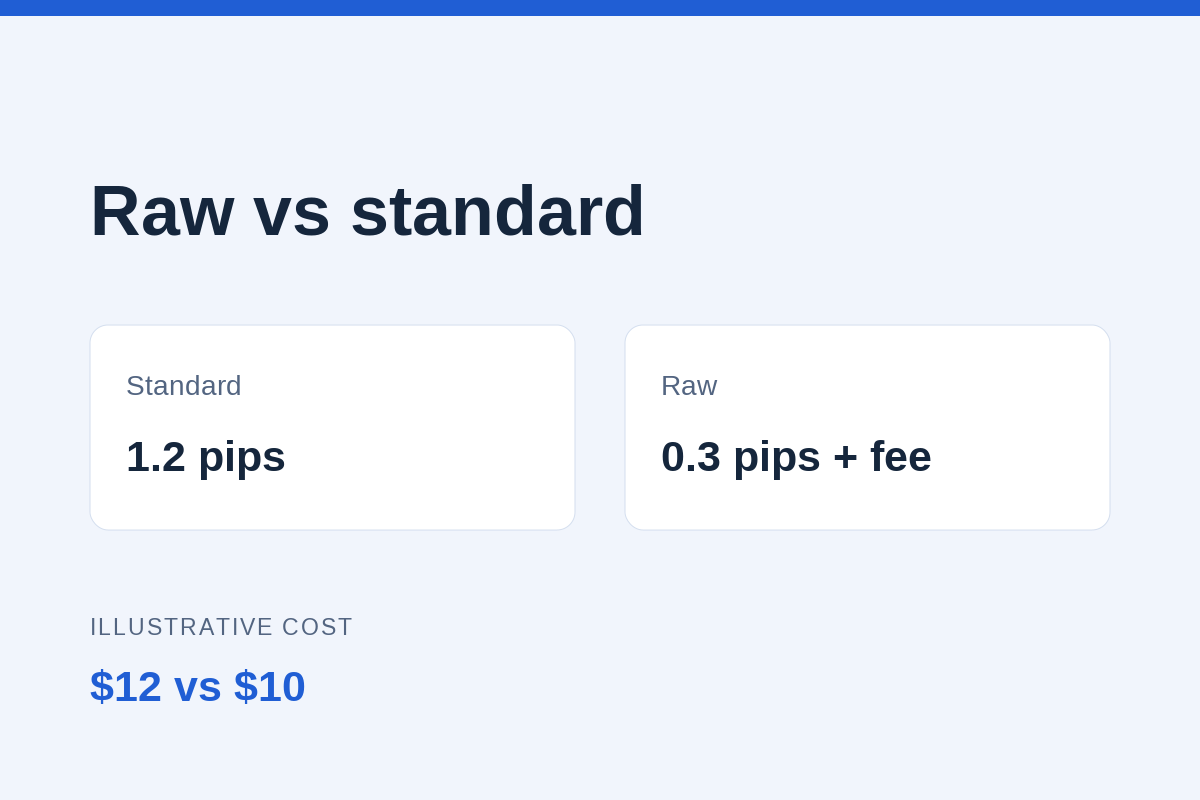
In briefIn the hypothetical example, standard costs $12 and raw costs $10 before other costs. With the same $7 round-trip commission, raw breaks even at a 0.5-pip spread.
Compare the complete charge, not the account label
Compare a raw spread account with a standard account by adding spread cost and any commission for the same trade size, then checking swaps, currency conversion and other fees separately. In the hypothetical EUR/USD example used here, a 1.2-pip standard spread costs $12, while a 0.3-pip raw spread plus $7 round-trip commission costs $10. That result describes these assumptions, not a permanent advantage for either account structure.
The useful distinction is between charging structures. A spread-led comparison focuses on the gap between the buying and selling prices; a commission-inclusive comparison also counts the explicit charge attached to the transaction. Neither an account name nor a prominently displayed spread is enough to establish the complete cost. Confirm the actual commission terms rather than assuming that every account called standard is commission-free.
This guide separates documented cost concepts from illustrative numbers. Spread, commission, swaps, conversion and other fees are the components to investigate. The numerical examples are hypothetical and are not quotations from a named broker. Their purpose is to show how to compare two offers consistently, without turning a small example into an account ranking.
Start by writing down the instrument, position size, account currency and intended holding period. Those details establish what needs to match. If one illustration uses a different size or currency, its money total cannot simply be placed beside the other and treated as a like-for-like result.
A related comparison trap is explained in our guide to zero-spread forex brokers: a spread figure should be considered alongside the rest of the charging structure, rather than used as a complete cost measure.
Work through the same EUR/USD trade
Assume an identical EUR/USD position under both structures, with a pip value of $10. For this example only, the standard account has a 1.2-pip spread and no separate commission. Its spread cost is 1.2 multiplied by $10, giving $12. This is the spread-and-commission comparison, not a statement that every possible charge has already been included.
Now assume the raw account has a 0.3-pip spread and charges $3.50 on each side for that same position. Its spread cost is $3. Opening commission is $3.50 and closing commission is another $3.50, so round-trip commission is $7. Adding the spread cost produces $10. The raw structure is therefore $2 lower in this hypothetical comparison before other costs.
The phrase each side matters. Comparing $3 of spread plus only one $3.50 commission charge with the standard account would omit part of the transaction. Likewise, applying a commission quoted for a different position size would break the comparison. Record both the charge basis and whether the quoted amount covers one side or the complete opening-and-closing transaction.
The $10 pip value is an explicit assumption, not a universal value to copy into another trade. Keep all amounts in the same currency before adding them. If the commission is presented in another currency, the conversion needs to be established rather than silently treating the two currency amounts as interchangeable.
Spread plus round-trip commission
The standard-account comparison is 1.2 × $10 = $12, making the illustrative difference $2.
Find where the two structures break even
A break-even calculation makes the comparison more useful than a single snapshot. Keep the standard account at $12, the pip value at $10 and raw round-trip commission at $7. That leaves $5 available for the raw spread before its total reaches $12. Dividing $5 by $10 per pip gives a break-even raw spread of 0.5 pips.
Under those unchanged assumptions, a raw spread below 0.5 pips produces a lower spread-plus-commission total; a raw spread above 0.5 pips produces a higher total. At exactly 0.5 pips the totals match. These are arithmetic outcomes, not predictions about how often a particular spread will be available or what a trade will ultimately cost.
The table changes only the raw spread. Its purpose is to isolate that variable, not to suggest a likely spread range. The standard comparison remains $12 throughout, and swaps, conversion and other fees remain outside the calculation. If either account's other charges differ, the complete-cost break-even point needs to be recalculated.
Use this threshold as a checking tool rather than a selection rule. A comparison built from a standard spread observed at one time and a raw spread observed at another may be internally neat but poorly matched. The arithmetic only answers the question posed by its inputs.
Use the spread-cost toolas a companion to the calculation, keeping the position size and currency consistent and checking separately which commission and other charges still need adding.
| Raw spread | Spread plus commission | Against standard |
|---|---|---|
| 0.3 pips | $3 + $7 = $10 | $2 lower |
| 0.5 pips | $5 + $7 = $12 | Equal |
| 0.7 pips | $7 + $7 = $14 | $2 higher |
Hypothetical raw costs with a $10 pip value and $7 round-trip commission; standard remains $12.
Compare typical spreads at comparable times
A minimum spread and a typical spread answer different questions. For this comparison, seek typical figures measured on a comparable basis, rather than putting one account's lowest advertised figure beside another account's broader measure. Check what each spread figure represents, the instrument it covers and the period to which it relates. If the basis is unclear, mark the comparison as incomplete.
Timing also needs to match. A hypothetical comparison might record both account types for EUR/USD at the same observation times and use the same position assumptions. Its conclusion should stay within that evidence: those observations support that comparison, not a claim about every trading period. Avoid filling gaps with an assumption that one displayed number applies whenever you trade.
Keep the quoted cost comparison separate from execution. A raw label does not establish interbank access or superior fills. Nor does a narrower displayed spread, by itself, settle the difference between an expected transaction price and the price achieved. Account charging and execution are related questions to investigate, but they are not interchangeable evidence.
A practical comparison sheet should therefore distinguish the source of a spread figure from a record of an actual execution. Label each clearly. If you have only published charging information, describe the result as a comparison of stated costs rather than presenting it as proof of the outcome of a completed trade.
For the separate execution question, read what forex slippage means. Do not use the raw-versus-standard cost calculation as a substitute for examining execution information.
Check swaps, conversion and fees separately
Once spread and commission are aligned, give the remaining costs their own lines. Check the swap terms relevant to the intended holding period, the currency-conversion terms and any other applicable fees. Separating these items prevents a tidy spread calculation from being mistaken for a complete account-cost assessment.
For swaps, establish whether the planned holding period brings a swap into scope and use the terms applicable to the instrument and position direction. Do not insert an assumed swap amount merely to finish the worksheet. If the required information is missing, retain an explicit unknown. The $10-versus-$12 example does not establish either account's swap charge.
For conversion, identify the currency of each charge and the currency used for the comparison. A hypothetical dollar-denominated commission and a comparison prepared in sterling need a consistent conversion basis before the final totals can be compared. Record any applicable conversion charge separately, rather than hiding it inside a spread figure or confusing it with commission.
Other fees also need a stated basis and scope. Ask whether each applies to the intended activity, and avoid allocating an account-level charge to a single trade without explaining the method. Where an item is identical on both sides, say so; where it is unknown, do not replace it with zero. An incomplete comparison can still be useful if its limits remain visible.
Our explanation of swaps in forexprovides a separate starting point for that holding-cost check. Keep it distinct from the opening-and-closing commission calculation.
Build a repeatable comparison sheet
Imagine comparing two hypothetical EUR/USD account schedules for the same position. Instead of copying the largest spread headline, create a short record that another reader could reproduce. Include the observation date, spread basis, pip value, commission basis and comparison currency. Then show the arithmetic rather than recording only the final total.
Keep assumptions and confirmed terms visibly separate. In this guide, $10 per pip, 1.2 pips, 0.3 pips and $3.50 each side are illustrative inputs. In your own worksheet, each replacement input should have a clear basis. If a commission schedule uses a different size convention, resolve that mismatch before calculating.
Finally, preserve the subtotals. Show spread plus commission first, then add applicable holding, conversion and other costs. This makes it possible to see why two totals differ and to update one input without rebuilding the comparison. It also stops a missing item from disappearing behind an apparently precise final figure.
If account terminology is complicating the exercise, use our guide to ECN forex brokersas a separate terminology reference. A label is not evidence of either the total cost or the quality of a fill.
Check the hypothetical EUR/USD comparison
Use the same EUR/USD position, $10 pip value, comparison currency and holding assumptions.
Compare typical spreads at comparable times and confirm what each figure measures.
Add $3.50 opening and $3.50 closing commission to the raw spread cost.
Check swaps, conversion and other fees; label missing information rather than assuming zero.
State the result without turning it into a ranking
A defensible conclusion is specific: under the hypothetical inputs, raw costs $10 and standard costs $12 before other costs, with equality at a 0.5-pip raw spread. It is not defensible to shorten that to raw is always cheaper. The conclusion changes if the spread, commission, size, currency basis or other relevant costs change.
Before accepting any comparison, check that both columns describe the same transaction and include the same cost categories. Confirm that commission covers both sides, that typical spread figures are comparable and that unknown charges remain marked. Then ask whether the wording distinguishes stated charging terms from hypothetical calculations and actual execution evidence.
The final output need not name a winner. A useful result may identify a break-even threshold, an unresolved conversion term or missing swap information. That is more informative than a ranking built on unmatched inputs. Compare charging structures on their evidence, and keep platform preferences and execution questions alongside the cost analysis rather than using them to replace it.
If you are also comparing platforms, treat our guide to MT4 forex brokersas a separate research route. Platform choice does not remove the need to calculate spread, round-trip commission and other applicable costs.