In briefIdentify the hosting model, separate server-held instructions from runtime-dependent actions, and use demo checks to establish one active runtime before testing interruptions or restarts.
What a forex VPS can—and cannot—fix
A forex VPS can move a trading application's runtime away from your own computer; it cannot make a strategy sound, guarantee fills or establish uninterrupted operation. The useful question is not simply whether software is “in the cloud”, but which software is running there, what it depends on and what happens when it stops. Generic remote operating systems, MetaTrader integrated virtual hosting and cTrader cBot cloud represent different hosting models, so checks for one should not automatically be applied to another.
MetaTrader virtual hosting has two consequences worth checking before migration. A robot that calls a DLL locally cannot rely on that dependency in the hosted environment. And a hosted Expert Advisor can run even if automated trading is disabled in the local terminal. Check the hosted instance and its journal rather than using the desktop toggle as a remote stop button.
As a hypothetical example, imagine an EA intended to adjust an order when a condition appears. Moving that EA may address its dependence on the home computer remaining active, but only if the intended process actually runs in the destination environment. It does not establish that the adjustment will be accepted or produce the intended result. This guide therefore treats hosting as an operational question, with checks performed on demo rather than as a recommendation to automate trading.
For the platform-selection context behind these distinctions, use the forex platforms comparison to frame which environment you are assessing before investigating its hosting workflow.
Separate the three hosting models
A generic remote operating system is a remote computer environment in which the application setup must be understood separately from the hosting arrangement. Assess the operating system, terminal, strategy files and supporting components as individual parts. A remote desktop that opens successfully is not, by itself, evidence that the intended trading process has started, received current data or loaded the correct configuration.
MetaTrader integrated virtual hosting should instead be understood through its documented migration workflow. Do not treat it as interchangeable with a general-purpose remote desktop. Identify what the migration is intended to transfer and check the hosted result. In particular, a strategy's reliance on DLL calls is material because MetaTrader documents a DLL restriction for this environment. A familiar local setup does not establish compatibility.
cTrader cBot cloud is a third model: cloud execution for cBots within the cTrader ecosystem. Its cloud-feature documentation is the relevant reference for checking support and workflow. Do not import assumptions about MetaTrader migration or general remote-machine administration into that assessment. Equally, the existence of cBot cloud does not establish that every dependency in a particular project is supported. The practical comparison is between the actual project requirements and the selected environment, not between three products all labelled “VPS”.
For any model, record the application or bot name, intended demo account, configuration identifier and expected runtime location. This creates a concrete target against which the deployment can be checked.
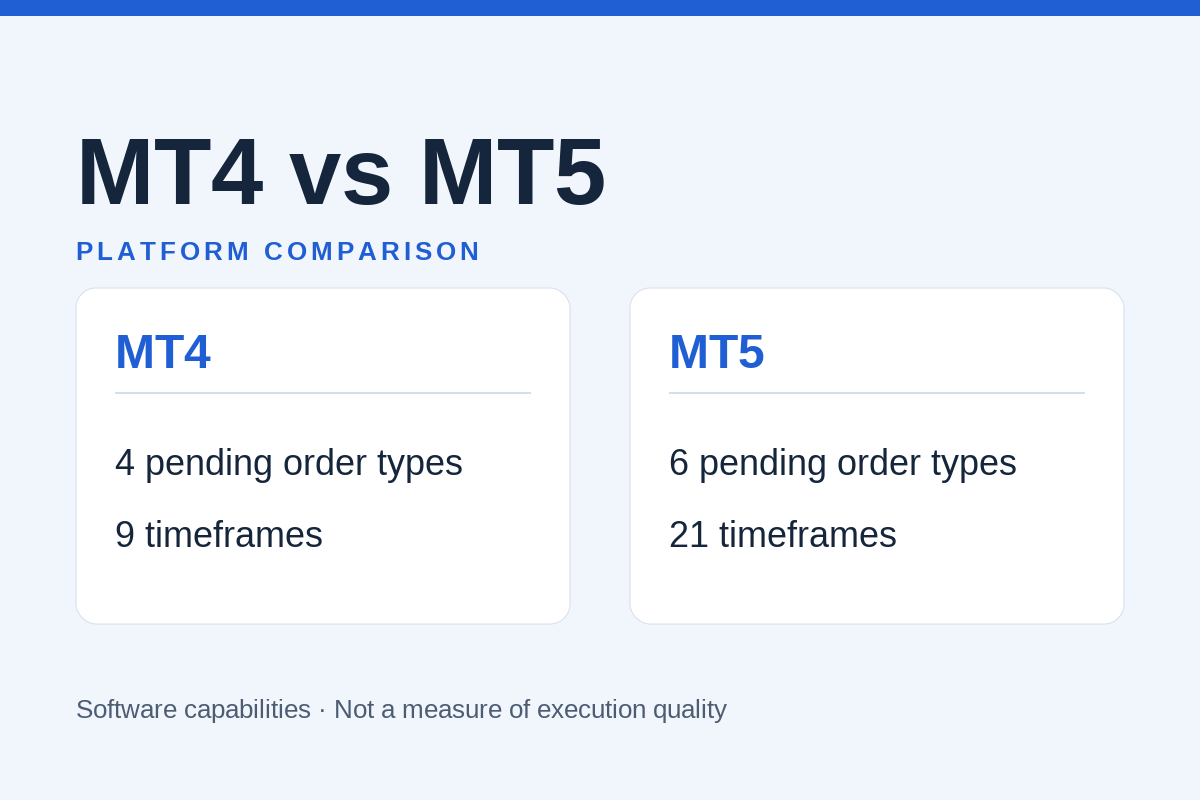
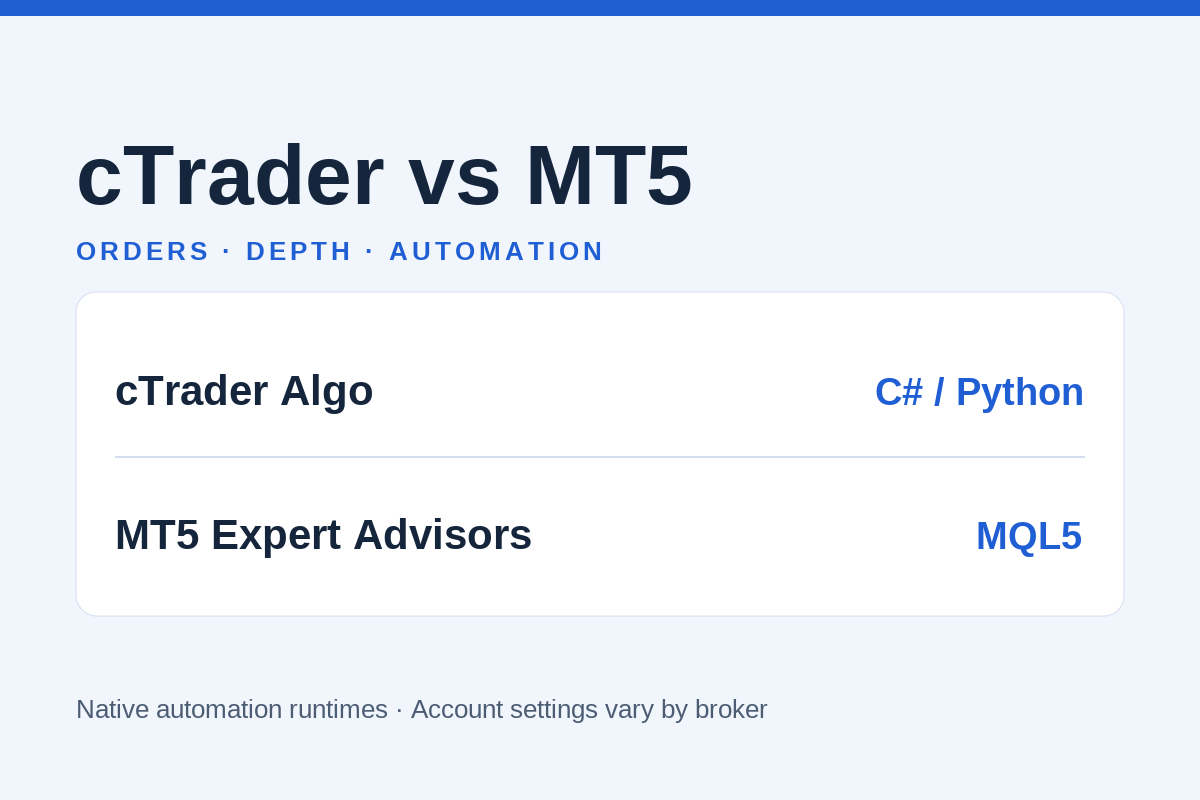
Keep platform differences separate from hosting assumptions when reading cTrader versus MT5; the execution environment still needs its own project-specific check.
| Model | What to establish | Assumption to avoid |
|---|---|---|
| Generic remote OS | Which applications and dependencies are installed and running | Remote desktop access proves the strategy is active |
| MetaTrader virtual hosting | Migration result and compatibility with documented restrictions | It behaves like an unrestricted remote OS |
| cTrader cBot cloud | The cBot's requirements against cloud-feature documentation | Another platform's hosting rules apply |
Three hosting models, with a different verification starting point for each.
Identify where each action happens
Separate instructions already accepted and held by a trading server from actions that still require the terminal or bot to calculate something and submit a request. Hosting primarily concerns the latter runtime. For each strategy action, ask whether the necessary instruction already exists on the server or whether software must remain active to create or change it. Do not classify an action from its marketing label alone.
Consider a hypothetical strategy with an existing order and a later rule to revise that order after a new signal. These are two separate states to inspect: what the server currently holds and what the strategy intends to request next. Seeing the existing order is not evidence that the later rule remains operational. Conversely, losing the local screen does not by itself tell you whether an instruction already held elsewhere has disappeared.
Create a short action map covering signal calculation, order submission, later modifications and any planned cancellation. Beside each action, name its responsible component and the evidence you would inspect. Where responsibility is unclear, leave it unresolved until a demo observation or the relevant documentation establishes it. This avoids attributing every outcome either to “the VPS” or “the broker”.
For a platform comparison, carry that same action map between environments rather than assuming identical behaviour. The important output is an explicit account of what needs a running process, not a general claim that all orders either survive or fail when a terminal closes.
The MT4 versus MT5 comparison provides a separate platform context; verify the responsibility for each action in the particular setup being tested.
Establish one active runtime on demo
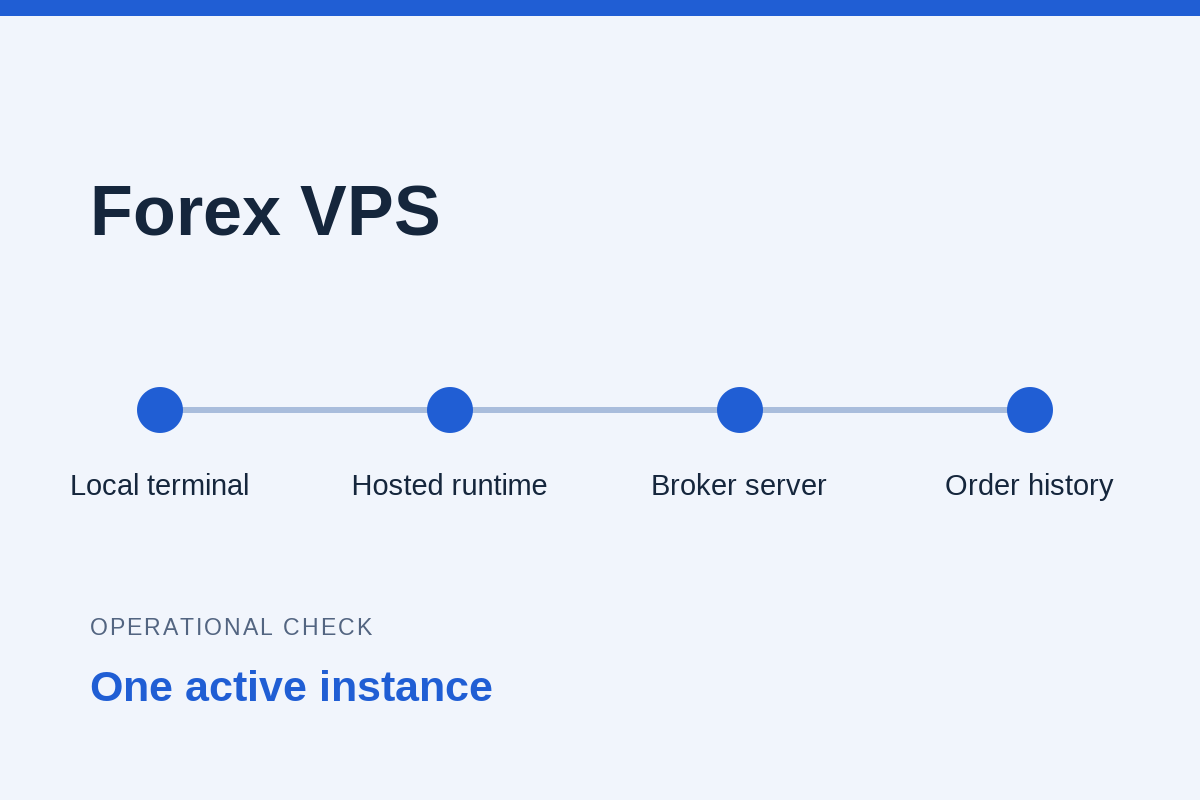
Before testing interruptions, establish which single runtime is intended to act on the demo account. A local terminal, an old remote setup and a newly hosted instance are distinct candidates to inspect. Do not infer exclusivity merely because one window has been closed or one local control has changed. Record the intended active instance and check the others before generating a test signal.
MetaTrader's documented distinction is critical here: hosted EAs can operate even when local automated trading is disabled. Therefore, that local switch is not evidence that hosted execution has stopped. Use the hosting workflow and available records to establish the hosted state. If you cannot determine which instance is active, pause the test rather than treating an unexplained order as confirmation of successful deployment.
The hypothetical sequence below uses one EA and one demo account. Its purpose is to establish responsibility for observed actions, not to test returns. Define the expected event in advance, then compare the demo account record with the intended runtime's records. If two unexplained requests appear, investigate runtime overlap and strategy logic separately; duplication should not automatically be attributed to hosting.
Keep the setup identifiable without putting secrets into screenshots or notes. Use descriptive labels for the demo account and configuration, and do not share credentials to obtain troubleshooting help. A useful test record explains what ran and what happened without exposing access details.
Hypothetical demo handover: one EA, one intended runtime
List local, remote and hosted instances associated with the demo setup.
Use the relevant controls and records to establish one intended active instance.
Generate a defined demo event and compare runtime records with account activity.
Resolve missing or duplicate actions before introducing an interruption.
Check dependencies and data freshness separately
An application starting successfully is only one checkpoint. Inventory the components the strategy actually uses: its code, settings, required files, libraries and any external input. Treat these as project-specific questions, not as a claim that every hosting model supports them. For each dependency, record how its presence or compatibility will be demonstrated in the chosen environment.
MetaTrader's DLL restriction is a documented compatibility boundary for integrated virtual hosting. If a hypothetical EA relies on a DLL, do not assume migration removes that reliance or makes the call permissible. Identify the dependency before testing and consult the documented restriction. For cTrader cloud, perform the equivalent requirements check against its cloud-feature documentation rather than borrowing MetaTrader's rules.
Data freshness needs a separate check from application activity. In a hypothetical incident, a bot might produce recent log entries while the data it evaluates is older than the test expects. Compare the time of the relevant input with the time of the decision, accounting for the timestamp conventions shown in the records. A recently opened screen or newly written message alone does not establish fresh input.
Define what counts as acceptable evidence before the test: the expected input, its timestamp, the decision recorded and the resulting request, if any. An unexplained gap should remain an unresolved finding. Avoid turning a successful startup into a broader claim that every dependency and data path has been validated.
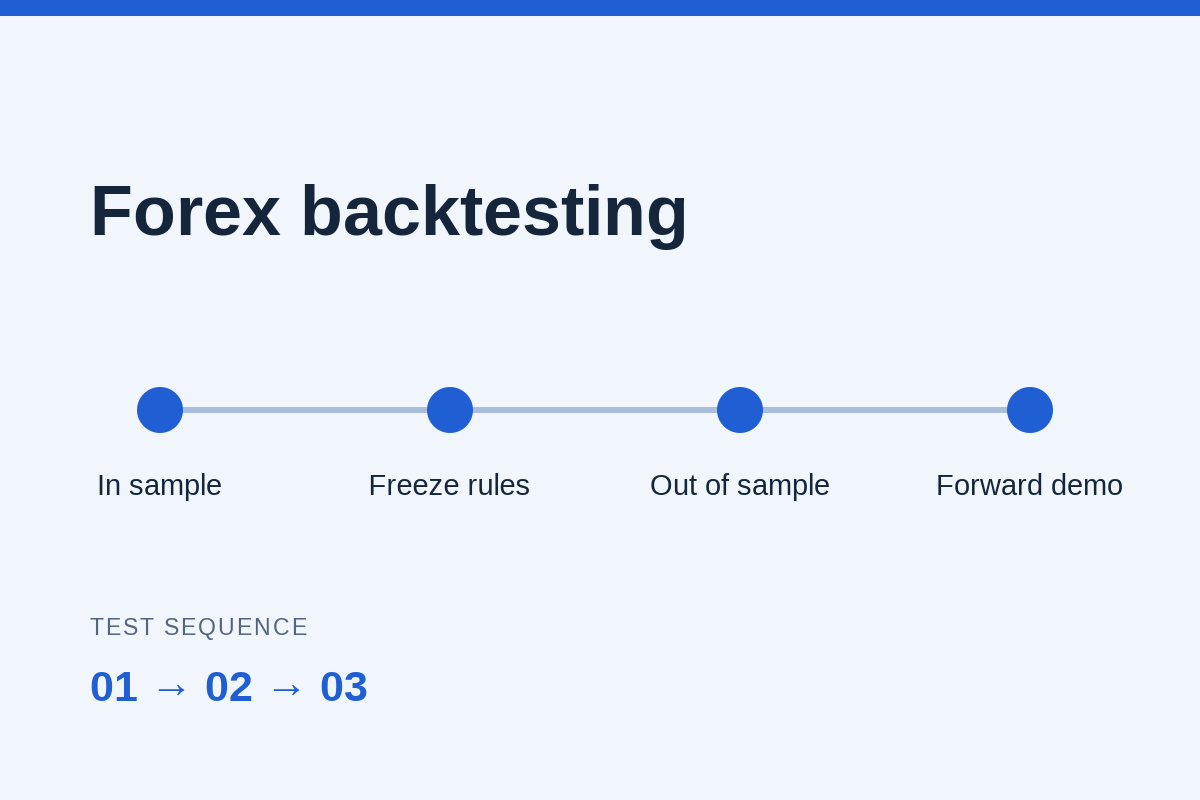
Keep operational validation distinct from historical strategy testing; the forex backtesting guide addresses a different part of the evaluation process.
Reconstruct events across a restart
A restart check should answer a defined operational question: does the intended demo setup resume in the state you expected? Record the pre-restart configuration, visible account state and relevant timestamps. Then compare those observations with the post-restart records. Do not assume that reopening a terminal proves the strategy resumed, or that a resumed strategy necessarily recognised earlier actions.
For a hypothetical example, suppose the demo strategy records a signal shortly before an interruption. Afterwards, one request is visible in the account history. Establish whether it relates to the earlier signal or to a new decision after restart. If two requests appear, inspect their sequence and the active-runtime record. The evidence may point towards repeated strategy logic, overlapping instances or an unresolved cause; the count alone does not distinguish them.
Use logs to connect events rather than to collect reassuring screenshots. Look for the relevant startup, configuration, input, decision and request records where available. Compare them with account-side records, and preserve error messages exactly while removing credentials or other sensitive details. Where the environment does not expose a particular record, note that visibility gap instead of inventing certainty.
A quiet period is also ambiguous. It might match the strategy's conditions, or it might require investigation. A defined demo event gives that silence context. The three evidence groups below serve different teaching roles: intended state, observed software activity and recorded account outcome.
Three evidence groups for a restart check
Runtime identity, configuration and the event expected in the demo test.
Available startup, input, decision and request entries around the interruption.
Recorded orders or changes, checked against the expected sequence.
Draw a narrow conclusion from the evidence
Finish with a written result that is narrower than “the VPS works”. A useful hypothetical conclusion is: “In this demo test, the identified hosted instance recorded the defined event after restart, and the account record showed one corresponding request.” That states the environment, observation and limit. It does not turn a single test into a promise about future uptime, fills or other conditions.
Separate resolved checks from open questions. You may have established the active runtime while still lacking evidence about a dependency or an interruption scenario. Keep those findings distinct. If the records do not explain an action, preserve the uncertainty rather than selecting the most convenient explanation. Repeat testing should answer a specific unresolved question, not merely accumulate more uneventful running time.
The final hosting decision should therefore rest on a clear operational description: which model is being assessed, which actions need its runtime, which dependencies have been checked and how restarts or duplicates will be investigated. Remote hosting changes the location of execution. It does not remove the need to understand execution.
Keep the limits of the test explicit with the demo versus live account guide; the checks described here establish observations on demo, not live outcomes.
For broader evaluation questions, consult the algorithmic-trading broker guide without treating broker selection as a substitute for validating the runtime itself.