In briefCompare the same hypothetical position under dated terms for the correct legal entity, counting administrative billing events and any overnight credits foregone separately from spreads and commissions.
What a swap-free forex account does—and does not—tell you
A swap-free forex account changes how overnight holding is treated, but the label alone does not establish that holding a position is free. The essential checks are whether an administrative charge applies, when charging starts, what unit is billed, who is eligible and which instruments the policy covers. Compare those terms with the ordinary account’s overnight debits or credits, keeping spreads and commissions separate.
The distinction is between an overnight adjustment and a separate administrative charge. An overnight adjustment is the debit or credit associated with carrying a position under the ordinary account’s rules. An administrative charge is a different charging mechanism that may appear in swap-free terms. Its trigger, frequency and calculation must come from the applicable schedule; do not assume that removing one charge removes every holding-related cost.
Start with the swap-free terms attached to your account agreement. Use the separate costs-and-charges examples to check how a fee is calculated, not to assume that the same rate or holding period applies to you. If the examples use a different instrument or contracting company, write down that difference and use your own tariff instead.
This guide does not rank brokers or give a religious ruling. It explains how to read and compare the charging arrangement. Every numerical scenario below is hypothetical rather than a quotation from a provider’s current schedule, and no universal grace period or administrative fee is assumed.
For the underlying terminology, read what a swap is in forex before interpreting an account’s replacement charging rules.
Establish eligibility and the policy’s legal scope
Start with the legal entity that would provide the account, rather than the trading brand alone. Ask for its full name and the documents governing that particular relationship. A swap-free policy should be read within its own stated scope: an entity named in one document does not establish eligibility under another entity’s agreement.
Next, establish what eligibility actually means in the relevant terms. Ask whether the arrangement requires an application or approval, what information is needed and how acceptance is confirmed. These are questions to resolve, not assertions that every provider uses the same process. Do not treat access to a platform, a marketing label or a general account description as confirmation of swap-free status.
Instrument coverage needs a separate check. Ask which forex pairs and account types are covered and whether the schedule identifies exclusions or different treatments. Then check the effective date and any provisions governing changes to eligibility or charges. The useful evidence is the wording applicable to your account, not an undated summary detached from its conditions.
Keep religious assessment distinct from the administrative task of verifying a contract. The phrase ‘swap-free’ describes an account feature; it does not, by itself, settle questions about religious permissibility. Likewise, checking regulatory identity helps establish who the contracting firm is, but it does not answer how a particular fee is calculated.
Use the guide to checking a forex broker’s regulation to structure the identity check, then match that entity to the account documents.
For the separate religious question, see the discussion of whether forex trading is halal; this fee guide does not reach a religious conclusion.
Read the fee unit before comparing the number
A fee figure is incomplete without its unit. Ask whether the amount is expressed per position, per lot, per another stated size or per billing event. Also establish the currency of the charge. A bare ‘4’ cannot be compared meaningfully with another figure until the size basis, currency and charging frequency are known.
Treat the charge trigger and the charge amount as separate fields. The trigger tells you when a liability arises; the amount and unit tell you how it is measured. Ask whether the schedule treats long and short positions differently, rather than assuming either symmetry or a difference. Read any instrument-specific entry alongside the general policy.
The following checklist is a document-reading aid, not a description of any named provider’s terms. Record the exact wording where possible. If support supplies an explanation, ask which dated contractual provision or fee-schedule entry supports it. That gives you something concrete to reconcile if two descriptions appear inconsistent.
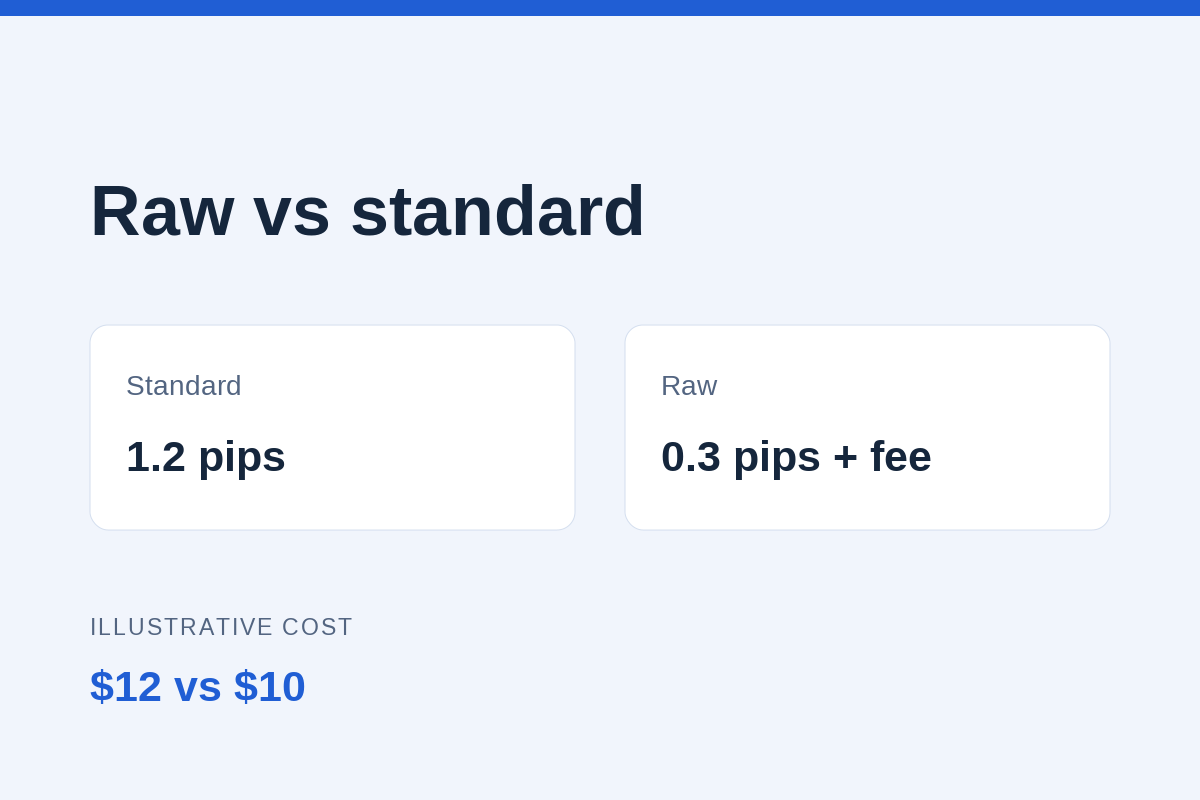
Keep trading-price structure distinct by reviewing raw-spread versus standard accounts separately from the swap-free holding rules.
| Field | Practical check | Why it matters |
|---|---|---|
| Charging unit | Identify the position-size basis and billing event. | The headline number alone is not a comparable cost. |
| Currency | Record the stated charging currency. | Avoid comparing unlike monetary amounts. |
| Timing | Find the trigger and subsequent billing rule. | Elapsed time alone may not identify chargeable events. |
| Direction and scope | Check the pair, long or short direction, account and entity. | An entry must apply to the position being tested. |
| Effective date | Retain the dated schedule and relevant conditions. | A comparison needs an identifiable set of terms. |
Fields to extract from the applicable swap-free schedule
Map any grace period onto a specific timeline
A grace period, where the applicable terms provide one, is only useful once its counting rule is clear. Do not assume a standard number of days or nights. Ask when counting begins, what marks the end of the period and which event first becomes billable. The document must supply those details.
For a hypothetical position opened on Monday and closed on Friday, the weekday labels do not establish the fee. You still need the relevant timestamps and charging rules. Write down the opening and closing times, identify any stated free interval and mark the billing events falling within the holding period. Do not substitute ‘four days’ for that exercise.
If the wording leaves an edge case unresolved, ask a precise question: ‘For this opening time and this closing time, which events would be charged under the attached schedule?’ Ask for the answer’s time basis too. This is more useful than asking how many free nights an account has, because it tests the rule against a reproducible scenario.
Test a Monday-to-Friday hypothetical holding
Record Monday’s opening timestamp, Friday’s closing timestamp, pair, direction and position size.
Use the dated schedule’s counting method and any stated grace period.
Identify each chargeable event inside the holding window; query ambiguous boundaries.
Apply the documented fee unit without adding assumed charges or assumed free time.
Calculate the administrative component separately
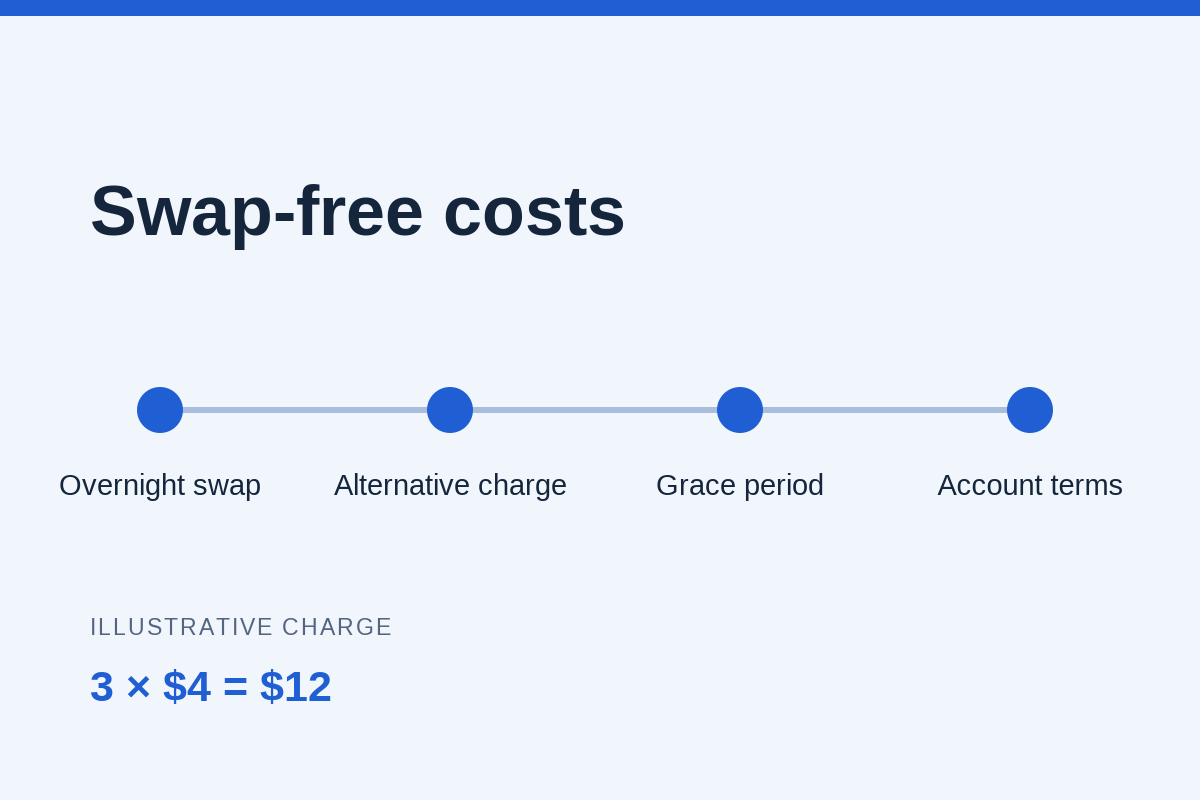
Consider a deliberately simplified hypothetical: the applicable rules produce exactly three chargeable billing events, and each event costs $4 for the unchanged position being tested. The administrative component is three multiplied by $4, or $12. The example assumes the event count and the amount; it does not establish either for a real account.
That $12 is separate from spreads and commissions. It is not a total trading-cost figure, a measure of the position’s profit or loss, or evidence that one account is cheaper. To build a fuller comparison, record the other applicable components in separate lines rather than silently including them in the administrative fee.
This example also shows why event counting comes before multiplication. If a schedule quotes a different size basis, the assumed $4 per event cannot simply be reused. First resolve the unit and any required size calculation from the terms. Only then can the number of billing events be multiplied by the applicable amount.
Three hypothetical billing events
The calculation assumes three qualifying events at a flat $4 each for this position. It implies no universal fee or grace period.
Compare both directions without overlooking credits
A fair comparison holds the hypothetical position unchanged: same pair, direction, size, opening time and closing time. Calculate the ordinary account’s overnight treatment and the swap-free account’s administrative treatment separately. If you change the holding period or position size between the two, the result no longer isolates the charging arrangement.
Include credits as well as debits in the ordinary-account side. Where that account’s applicable terms would produce an overnight credit, establish whether choosing swap-free treatment means foregoing it. The comparison is not simply ‘a charge versus no charge’. A credit not received is relevant to the difference between arrangements, even though it is not an administrative invoice.
Test long and short scenarios independently using their applicable entries. Do not assume both directions attract the same overnight adjustment, or that either necessarily receives a credit. Keep the sign visible in your worksheet: label amounts as debits or credits rather than leaving an unexplained positive number. Then list administrative charges, spreads and commissions separately.
For the hypothetical $12 administrative component, no conclusion follows until the ordinary account’s treatment and other applicable costs are known. The exercise is a comparison method, not a recommendation to choose either account type.
Use the swap-cost tool only with inputs matching the applicable terms; retain the separate administrative-fee calculation.
Ask for dated evidence and retain the comparison
A focused request can read: ‘Please provide the dated swap-free fee schedule and governing terms for the legal entity offering this account. Please confirm eligibility, covered instruments, charging currency and unit, any grace-period counting rule, billing triggers, and the treatment of long and short positions, including ordinary overnight credits foregone.’
Attach your unchanged hypothetical position and ask which schedule entries apply. Request a worked breakdown separating administrative charges from spreads, commissions and ordinary overnight adjustments. If the response gives only a total, ask for its components and assumptions. A clear answer should let you reproduce the arithmetic without guessing the timing rule.
Save the schedule’s effective date, the applicable terms and the written clarification together. If you later repeat the comparison, check whether those inputs still apply rather than recycling the old total. The practical objective is modest: know who the policy covers, what triggers each charge and how the same hypothetical holding is treated under each arrangement.
Preserve the terms that applied on the date you compared the accounts. Save the fee schedule and write down the entity, instrument, direction, transaction currency, relevant time zone and the date on which a holding charge could begin. If the provider describes a charge by lot, get the lot definition rather than applying it to every instrument. If the document does not say whether there are different charges for weekends or holidays, mark that cell unknown. The useful comparison is between two documented schedules for the same trade idea, not between two marketing labels.
For holding-period context, the swing-trading broker guide is a separate resource; it does not replace the dated entity-specific documents needed for this calculation.