In briefFor the best forex brokers for swing trading shortlist, multi-night financing and gap exposure deserve more weight than a small entry-spread advantage. Capital.com, IG, OANDA EU, XTB and CMC Markets offer different platform routes for swing traders. Compare financing over your intended holding dates, then check alerts, mobile order management and stop terms for the exact account. This shortlist assesses documented suitability, not live execution performance or the cheapest total cost.
Best forex brokers for swing trading: five account options
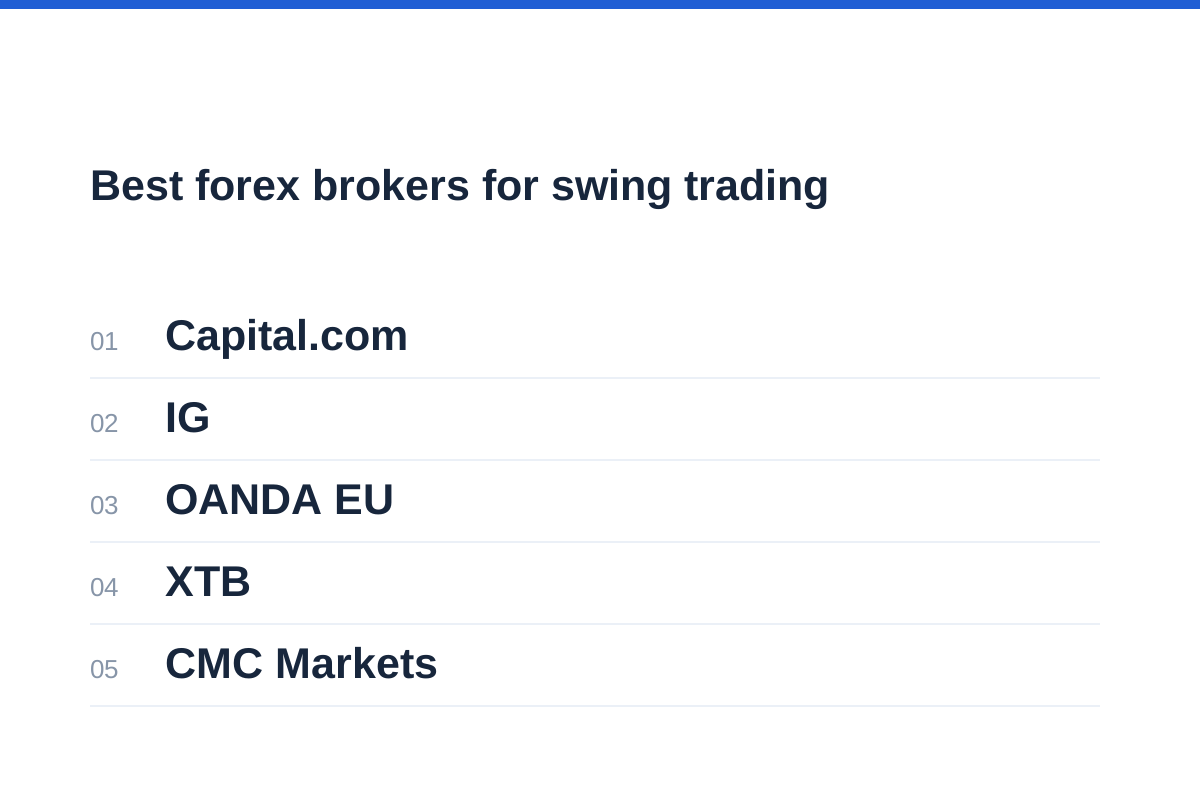
Capital.com, IG, OANDA EU, XTB and CMC Markets make up this five-brand shortlist. Capital.com combines mobile position management with published financing and guaranteed-stop terms. IG offers useful alert controls and demo practice, while OANDA EU suits eligible traders seeking TradingView access. XTB and CMC Markets provide desktop-to-mobile access, with different account checks required before committing.
Swing trading means holding positions across multiple sessions, often several nights. A slightly narrower opening spread can matter less than accumulated financing, an inconvenient rollover cut-off or difficulty changing an order while away from a desk. Leveraged forex and CFDs carry a high risk of loss and are not suitable for everyone.
The order prioritises tools for managing multi-night exposure: published funding terms, protective-order information, alerts and access away from a desk. It is not a ranking of investment returns, measured execution quality or overall broker quality. No deposits, fills or withdrawals were tested. Features and protections depend on residence, legal entity, product and platform; confirm the terms attached to your application.
| Order and broker | Reason to consider for swing trading | Account-specific check |
|---|---|---|
| 1. Capital.com | Mobile trade management, TradingView alerts and published guaranteed-stop terms | Pair-specific funding, stop availability and local eligibility |
| 2. IG | Price, technical and event alerts; web and MT4 demo practice | Regional platform access, funding and live-versus-demo differences |
| 3. OANDA EU | TradingView trading and trade modification for eligible CFD accounts | EU eligibility; TradingView unavailable on demos |
| 4. XTB | Desktop and mobile access; published swap and conversion information | Entity, pair-specific swaps and any swap-free time limits |
| 5. CMC Markets | Mobile access alongside its web platform | Exact mobile order controls, financing and local contract terms |
Start with the contract and the holding period
Retail forex commonly involves rolling spot FX or CFDs rather than delivery of currencies. The FCA includes rolling spot foreign exchange within its CFD framework. Deliverable spot FX, exchange-traded currency futures and institutional forwards have different settlement, funding and access arrangements; their costs are not directly interchangeable.
For a multi-night position, compare the same currency pair, direction, size, account currency and intended dates. Ask for the long and short financing schedules, rollover time, holiday adjustments and any commission. An attractive short-term quote does not establish a lower total holding cost.
Regulation must be checked at entity level. The FCA warns that similarly named overseas firms and transfers to associated entities can leave customers with different protections. UK retail CFD protections should not be assumed to apply to an EU or BVI contract.
Before evaluating platform conveniences, use our guide to checking whether a forex broker is regulated to match the application, register entry and client agreement.
- Prioritise a clear financing schedule over an unsupported claim of low costs.
- Check whether alerts and protective orders work independently of your device.
- Read margin close-out and execution terms before choosing position size.
Capital.com, IG, XTB and CMC: managing exposure between sessions
Capital.com takes first place for the combination of mobile position monitoring, trade management and published information on overnight funding and guaranteed stop-loss orders. Those functions address distinct swing-trading needs: checking exposure away from a desk, understanding carrying costs and limiting a specific form of gap risk. Its TradingView page also describes price, indicator and strategy alerts and trading directly from charts, subject to regional availability. Alerts help organise monitoring; they do not close a position by themselves.
Capital.com’s charges page says overnight adjustments can be paid or received and that a guaranteed-stop premium applies if the order is triggered. Check the actual currency pair, leverage setting and deal ticket rather than extending a general fee statement to every position. Its demo page explicitly warns that execution and liquidity may differ from live trading. MT4 supports live and demo CFD accounts under the listed ASIC, CySEC, SCA, FCA and SCB licences, excluding residents of France; MT5 availability depends on region and account type. Capital.com is unavailable in several countries and cannot serve US citizens regardless of residence.
IG ranks second for monitoring and rehearsal. Its international platform page describes price-level, price-change, technical-indicator and economic-calendar alerts, alongside stops and limits including guaranteed stops. These are useful when a multi-night trade spans scheduled announcements, although the applicable instruments, premiums and restrictions still need checking. International features must not be assumed to apply unchanged to a UK account or every third-party platform.
IG’s demo lets users practise alerts, deal tickets and position monitoring on its web platform, with MT4 demo access also documented. The UK MT4 page separately confirms demo accounts, mobile access and automated strategies. The international demo page makes important exclusions explicit: simulated trades are not subject to slippage, interest adjustments or out-of-hours price movements, and positions are not closed for insufficient margin as they can be live. It is therefore useful for learning controls, not validating a weekend-gap strategy or estimating actual holding costs.
XTB ranks fourth for cross-device access, with desktop and iOS/Android platforms documented. Its international fees page explains that some CFDs attract daily swap debits or credits and that transaction currency conversion can affect the result. The international account-and-fees page is tied to the Belize-regulated offering and advertises swap-free arrangements only for specified periods and products. Do not treat this as universal free overnight holding or apply those conditions to a UK or EU contract. Match the instrument specification and fee schedule to your legal entity.
CMC Markets ranks fifth as a web-and-mobile option rather than a specialist funding choice. Its platform page describes access to web-platform functionality on mobile. Before relying on that continuity, practise locating open positions, checking available margin and amending protective orders on your device. Confirm which order types and account warnings are available: mobile access alone does not establish identical functionality across every platform or favourable overnight charges.
For all five brands, test the essential workflow rather than counting indicators. Can you distinguish several positions in the same pair, see whether an amendment was accepted and find a backup access route? Check notification permissions and subscription requirements before depending on an alert during work or travel. Automated strategies also require their own operating arrangements; installing a mobile app does not establish that an algorithm will keep running when your computer is off.
Our Capital.com review provides broader account context; confirm that the local product matches the mobile workflow you intend to use.
Compare the account considerations in our XTB review with the actual platform and financing terms offered during your application.
OANDA: EU TradingView access and separate BVI restrictions
OANDA EU ranks third for eligible traders whose routine centres on TradingView. OANDA TMS Brokers documents the connection for clients located in the European Union using its CFDs account type. The integration supports trade execution and modification through TradingView, providing an alternative access channel to the account. TradingView features vary by subscription, although OANDA says a paid subscription is not required for the trading connection itself. Chart layouts and analytical tools can help organise a plan; they do not predict its outcome.
The rehearsal limitation is clear: both the EU integration page and dedicated demo help page state that TradingView is unavailable for demo accounts. EU demo access is through MT5 and the OANDA app. If rehearsing the exact TradingView order workflow is essential, resolve that limitation before opening a live account. Practising on another platform can teach general controls, but does not verify how the connected live ticket will behave.
OANDA Global Markets in the BVI is not a sixth broker or an interchangeable version of the EU account. Its help page documents live TradingView access and MT5, says MT4 sub-accounts are no longer provided, and states that demos can use only MT5, not TradingView. API functionality is unavailable for those clients. These restrictions matter if your monitoring or automation depends on a particular connection.
The BVI offering sits outside this ranked five-brand comparison. Its different contract and regulatory framework require a separate decision, not simply a software preference. The help page identifies OANDA Global Markets Ltd as authorised and regulated by the BVI Financial Services Commission. That does not establish UK retail protections. Confirm eligibility, client-money arrangements, margin rules and recourse under the agreement you would actually sign before comparing financing or platform convenience.
Read our OANDA review alongside the entity-specific agreement: a brand-level description cannot settle regional platform access.
Calculate the cost of the entire holding period
The best forex brokers for swing trading cannot be identified from minimum spreads alone. Overnight financing may be a debit or credit depending on the contract and direction, and the rate can change. Do not assume that a credit on one side simply mirrors the charge on the other.
Count financing units, not just calendar nights. A provider may apply several days of financing at one rollover to reflect settlement and weekends; holidays can alter the schedule. Obtain the actual convention rather than assuming every broker applies the same weekday adjustment.
Consider an illustrative EUR/USD position of 10,000 euros in a US-dollar account. At this size, one pip is approximately $1. A 1.2-pip spread costs approximately $1.20. If the assumed debit is $0.80 per financing unit and six units apply, financing adds $4.80: $6.00 combined before commission or slippage.
Use the swap-cost calculator to model your intended holding period with the provider’s quoted inputs, then check the units against its contract specification.
Build the comparison around the exit date
This assumes unchanged financing and excludes commission, conversion and slippage.
| Illustrative cost component | Calculation | Amount |
|---|---|---|
| Spread | 1.2 pips × $1 per pip | $1.20 |
| Financing | 6 units × $0.80 debit | $4.80 |
| Combined stated costs | $1.20 + $4.80 | $6.00 |
| Not included | Commission, conversion and slippage | Contract-dependent |
Plan for gaps, stop slippage and margin pressure
A conventional stop-loss is a trigger, not a promise of execution at the requested price. Around central-bank announcements or a weekend reopening, the next executable quote may be materially worse. A limit order controls the acceptable price but may not execute.
An illustrative long position entered at 1.0800 with a stop at 1.0750 has 50 pips of planned price risk. If the first executable bid after a gap is 1.0720, the move is 80 pips before other costs. On 10,000 euros of EUR/USD exposure, that is approximately $80 rather than $50.
A guaranteed stop, where contractually offered, can address that specific execution risk, but check eligible instruments, premiums and restrictions. Capital.com’s charges page documents guaranteed stops with a fee when triggered; IG’s international platform page also lists guaranteed stops. Neither statement establishes availability for every regional account or platform. Negative balance protection, where applicable, is different: it does not guarantee an individual stop price.
Margin pressure can also force an exit before a trade reaches its intended time horizon. Stress-test correlated positions together, including financing deductions and adverse conversion movements. A technical level is a planning reference, not evidence that a loss cannot exceed the planned amount.
The position-size calculator can translate a planned stop distance into exposure. Separately assess a gap beyond that distance.
Before carrying a position through a major event
Check announcements affecting both currencies and the next market reopening.
Model a worse exit than the stop trigger and inspect remaining margin.
Keep, reduce or close exposure according to your loss tolerance.
Confirm accepted orders and a backup access route.
Run a focused pre-account check
Ask each shortlisted provider the same written questions. Request the financing formula for your pair and direction, the next relevant rollover adjustments, stop-trigger rules and the procedure for managing an open position during a platform outage.
Use a demo to practise ticket entry, partial closures and order amendments where supported. Check whether alerts require a running terminal, a paid subscription or device permissions. A demo is useful for learning controls, but cannot establish live liquidity or future fills.
Finally, choose on the weakest essential requirement, not the longest feature list. If financing is unclear, resolve it first. If your routine depends on TradingView rehearsal, OANDA’s cited demo restrictions matter more than a promotional platform description. Retain a record of the terms used in your decision.
Our explanation of forex order types helps distinguish a pending entry, stop-loss and limit before you build this checklist.
Frequently asked questions
Which broker is best for holding forex positions overnight?
The right choice depends on your pair, direction, holding dates and monitoring needs. Capital.com heads this shortlist for its combination of mobile management and published funding and guaranteed-stop information; IG follows for alerts and demo practice. Neither is established here as the cheapest account for overnight holding.
Is a low spread more important than the swap charge?
Not necessarily. The spread is a transaction cost, while financing accumulates across applicable rollovers. Compare the combined cost over your intended holding period, including commission and currency conversion where relevant.
Can I test OANDA TradingView trading on a demo?
Not for the OANDA regional accounts covered here. OANDA EU specifies MT5 and its app for demos, excluding TradingView. OANDA Global Markets in the BVI restricts demos to MT5 and also excludes TradingView. IG documents web and MT4 demos, but these should not be assumed to reproduce a TradingView connection or live execution.
Will a stop-loss protect me over the weekend?
A conventional stop can trigger an exit, but a reopening gap may produce a worse fill. A guaranteed stop has different contractual terms where available. Neither an alert nor account-level negative balance protection guarantees a conventional stop price.
Should I close every position before major news?
There is no universal rule. Consider the potential loss, available margin, execution uncertainty and your ability to monitor. Reducing or closing exposure is an option when event risk exceeds what you can tolerate; chart analysis cannot remove that uncertainty.