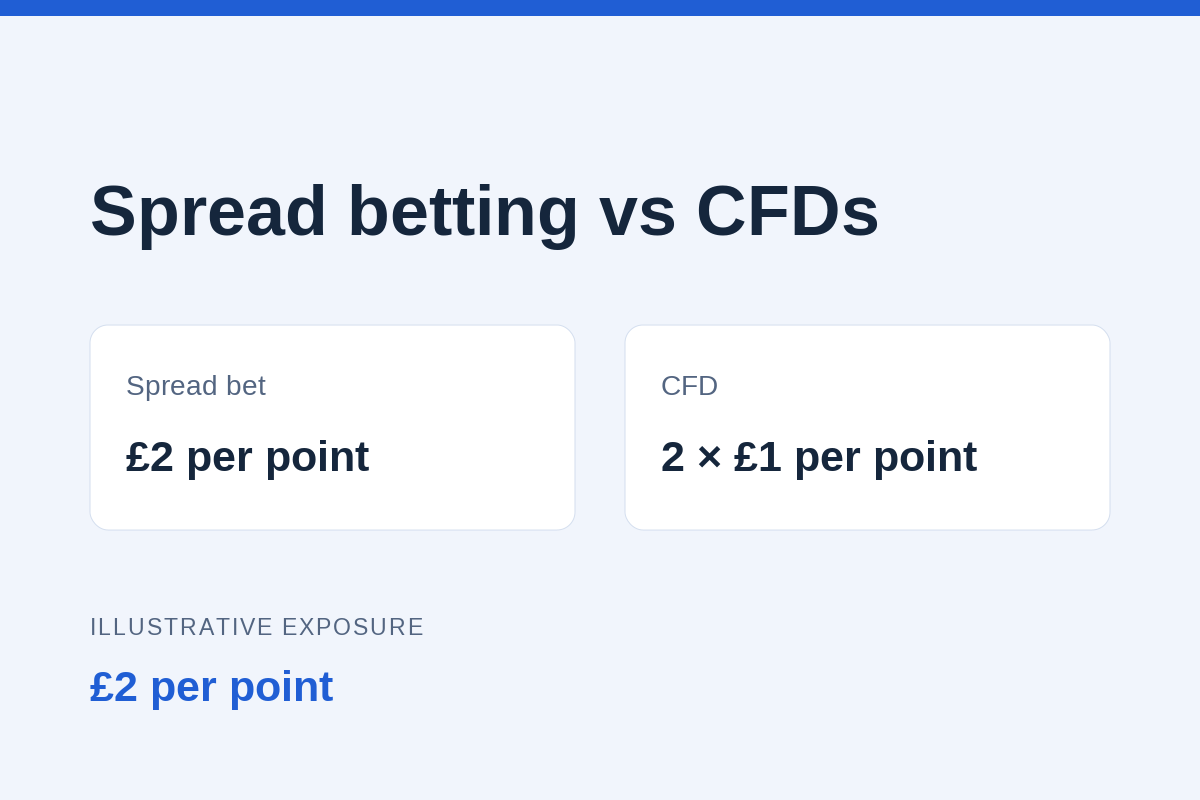
In briefCompare exposure per point before comparing product labels. A hypothetical £2-per-point spread bet and two CFDs worth £1 per point each both lose £30 on a 15-point adverse move before costs; margin requirements and tax treatment need separate checks.
Start with the contract, not the label
UK financial spread betting and contracts for difference, or CFDs, express trading exposure differently: spread betting uses a stake per point, while CFD exposure depends on quantity and the value of each point per contract. Neither comparison is about owning the underlying asset. To compare positions meaningfully, translate both into pounds gained or lost per point, then examine costs, margin and contract terms separately.
This guide concerns financial spread betting, not sports betting. Its focus is the structure of the trading contract: what a quoted movement means for the position, how size is expressed and what must be checked before treating two positions as comparable. Product names alone do not establish that two positions carry the same exposure or have the same costs.
The documented concepts and hypothetical calculations serve different purposes here. Stake per point, CFD quantity, margin risk and the need to examine costs are the comparison framework. The £2 stake, £1 CFD point value and 15-point adverse move used below are illustrative assumptions, not live specifications, market forecasts or terms offered by a named broker.
A useful contract comparison therefore begins with a small set of questions. What does the instrument call one point? How much money does that point represent at the selected size? What terms apply to holding and closing the position? Until those questions have answers, comparing a spread-betting stake with a CFD contract count can create a misleading impression of equivalence.
For the wider jurisdictional context, use the UK country guide alongside the instrument-specific contract information. Country context does not replace checking the terms of the actual position.
Translate stake and quantity into exposure
For a spread bet, the selected stake expresses the money associated with a one-point movement. In the hypothetical example, a £2-per-point stake means that each adverse point contributes £2 to the loss before costs. The important input is not simply the number 2, but its unit: pounds per point.
For the CFD example, assume each contract has a point value of £1. A quantity of two contracts therefore produces exposure of £2 per point. Quantity alone is incomplete information: two contracts cannot be compared with a £2-per-point stake unless the point value of those contracts is also known.
The table translates the two hypothetical positions into the same unit. This is a comparison of sensitivity to the stated price movement, not a statement that the contracts are identical. It does not establish matching margin requirements, charging terms or tax outcomes. Those remain separate checks even when the pounds-per-point figures match.
Before applying this method to actual contract information, confirm that the point definition and currency are comparable. Do not silently treat a displayed price increment as the same unit across different instruments. If the point definitions differ, resolve that difference first; otherwise, an apparently tidy comparison can be based on incompatible inputs.
| Input or result | Spread bet | CFD position |
|---|---|---|
| Selected size | £2 per point | 2 contracts |
| Assumed point value | Expressed directly in the stake | £1 per point per contract |
| Total exposure | £2 per point | 2 × £1 = £2 per point |
| Loss on 15 adverse points | £30 before costs | £30 before costs |
Hypothetical position sizes translated into pounds per point
Calculate the same adverse move both ways
Suppose the price moves 15 points against each hypothetical position. The spread-betting calculation is 15 points multiplied by £2 per point, giving a £30 loss before costs. The CFD calculation first combines two contracts with the assumed £1 point value, then applies the same 15-point movement. That also gives a £30 loss before costs.
The matching result follows from matching the exposure, not from any general rule that spread betting and CFDs always produce identical outcomes. Change the stake, quantity or contract point value and the comparison changes. Differences in costs must also be accounted for before comparing the overall monetary outcome of two positions.
The arithmetic is deliberately limited. It calculates the effect of the stated adverse price movement using the supplied assumptions. It does not calculate an account balance, a margin requirement or an exit level. Nor does the £30 figure establish a maximum possible loss: it is the result for this particular 15-point scenario.
A practical check is to write the units beside every number. Points multiplied by pounds per point produces pounds. For CFDs, contracts multiplied by pounds per point per contract first produces pounds per point. Keeping those units visible helps identify a missing contract multiplier or an assumption that has been copied from a different instrument.
One movement, two sizing conventions
The CFD quantity and assumed point value combine to match the spread bet's £2-per-point exposure.
Keep margin separate from the loss calculation
Margin belongs in a different part of the comparison from pounds per point. It concerns the funds required to support a position, rather than the position's sensitivity to a price move. Comparing only the margin figure can obscure how much money is exposed to each point of movement.
In the worked example, the adverse-move calculation remains £30 before costs because the assumed exposure is £2 per point and the movement is 15 points. No margin amount has been supplied, so there is no basis for calculating the funds needed to open either position or the account effect relative to those funds.
That distinction matters when considering margin risk. Do not read a funding requirement as a promise about the loss on a position, or assume that matching exposure means matching account requirements. Check the applicable margin terms and how adverse movements affect the funds supporting the position. Exact thresholds cannot be inferred from this example.
A useful comparison record keeps separate entries for exposure per point, required margin and the account rules relevant to maintaining the position. If one entry is missing, mark it as unresolved rather than substituting another figure. This prevents the £30 scenario loss, for example, from being mistaken for a required deposit or a stated loss limit.
For a fuller explanation of the funding concept, see what margin means in forex. Keep that conceptual explanation separate from the specific margin terms governing a spread bet or CFD.
Compare costs on the same assumptions
Equal exposure does not establish equal costs. The £30 losses above exclude costs, so they are not complete account-outcome comparisons. Before comparing the total monetary effect, identify the charges applicable to each proposed contract and the circumstances in which each charge applies. Do not assume a product label supplies a complete charging schedule.
Use the same scenario on both sides: the same instrument reference, comparable point definitions, matched exposure and the same intended holding period. Then check the quoted spread, whether any separate transaction charge applies and whether holding the position introduces a further charge. These are questions for the relevant terms, not claims that every contract has each type of charge.
Record how each applicable cost is expressed before trying to add figures together. A cost stated in points needs to be interpreted using the position's pounds-per-point exposure; a monetary amount needs its currency and basis checked. Where a charging rule depends on holding time, a price-movement-only example cannot supply the missing cost.
Avoid selecting a contract on one isolated cost label. A comparison that records only a spread, or only a separate fee, may omit another applicable element. Equally, do not add a charge merely because it appears in an educational example elsewhere. The aim is a documented list of applicable costs, with unknown items left visible.
If the terms refer to swap or holding-related concepts, the guide to swaps in forex provides a separate starting point for understanding the terminology; it does not establish the charge for a particular contract.
For another explanation of why charging labels need unpacking, see raw-spread versus standard accounts. Use that distinction as a prompt to inspect the full cost basis, not as evidence that either contract here is cheaper.
Treat regulatory checks and tax as separate questions
Regulatory checking is a different task from translating contract size. An accurate pounds-per-point calculation says nothing about the regulatory position of the firm offering the contract. Likewise, a regulatory check does not answer whether a particular stake or quantity matches the exposure someone intended to create.
Write down the legal company in the account agreement and check its permissions in the FCA register against the product on the ticket. A familiar trading name or a general FCA rule about CFDs does not tell you which company will hold your account or whether its permissions cover the product you selected.
Tax also requires its own boundary. HMRC distinguishes companies from individuals and considers circumstances. That means a broad comparison of financial spread betting and CFDs cannot support a universal tax-free promise or a personal conclusion about how a particular result will be treated.
The hypothetical £30 loss is therefore a contract-arithmetic figure before costs, not a tax calculation. It cannot establish relief, liability or the treatment of someone's wider activity. Keep any tax statement tied to its stated scope and circumstances rather than allowing a familiar product slogan to stand in for a supported conclusion.
Use the broker regulation checking guide as a structured starting point for the separate verification task. Contract arithmetic and firm verification should remain distinct parts of the review.
Build a comparison you can check
A useful comparison record should let another reader reproduce the arithmetic without guessing. State the instrument, point definition, currency, spread-betting stake, CFD quantity and CFD point value. Label hypothetical inputs explicitly, and keep actual contract information separate from assumptions used only to illustrate the method.
Next, apply one clearly stated adverse movement to both positions. In this guide, the matched £2-per-point exposure and 15 adverse points produce the same £30 loss before costs. Then add separate fields for applicable costs and margin terms rather than folding unknown amounts into that result.
Finally, list unresolved questions. Missing point values, unclear charging bases and unverified contract terms are gaps in the comparison, not reasons to estimate silently. The strongest conclusion available from this example is narrow but useful: two different sizing conventions can describe the same exposure, while the surrounding terms still require independent checking.
To place these sizing checks within a broader educational framework, see forex risk management. The essential habit here is to distinguish a calculated scenario loss from the other risks and terms that calculation does not resolve.
Check the hypothetical £2-per-point comparison
Confirm that the price movement uses a comparable point definition and currency.
Compare a £2-per-point stake with 2 CFDs assumed to be worth £1 per point each.
Use 15 adverse points: each hypothetical position loses £30 before costs.
Record applicable costs, margin requirements and unresolved contract questions separately.