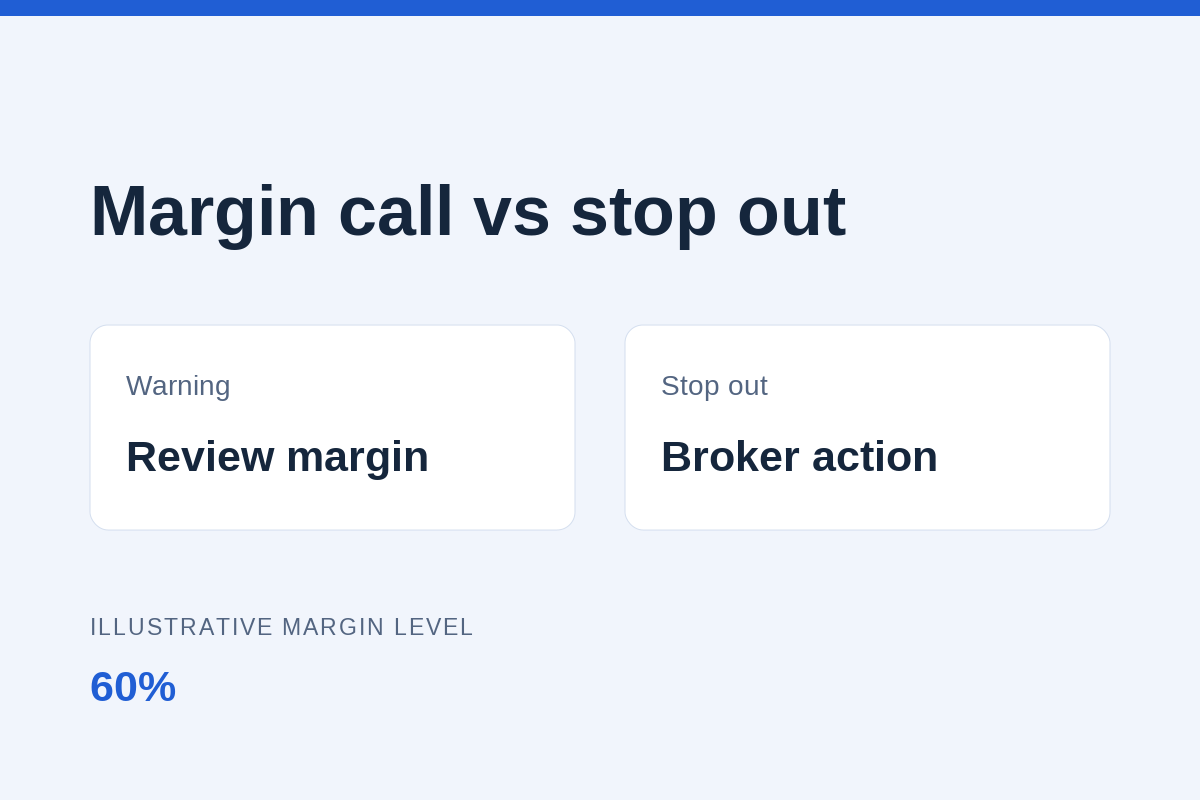
In briefA margin call concerns a margin shortfall or warning; stop out concerns automatic broker closeout; a stop loss is price-triggered. Check the account’s formula and rules rather than assuming a warning or universal threshold.
Margin call, stop out and stop loss: the direct comparison
A margin call is a warning or shortfall condition concerning an account’s margin, while stop out is automatic broker closeout under the applicable margin rules. A stop loss is different again: it is triggered by a specified price, not by the account reaching a margin threshold. These distinctions matter because a warning, forced closure and a price-triggered order answer three different questions about a trade or account.
The first question is whether the account meets its margin requirements. The second is whether the broker’s closeout condition has been reached. The third is whether the market has reached a stop-loss trigger. Calling all three a “stop” hides the trigger that matters and can lead to an incorrect reading of an account screen.
Treat the comparison below as a guide to the concepts, not a description of every broker’s terminology. Account documentation determines the actual definitions, calculation and response. In particular, the word “call” should not be read as a promise that someone will contact you before a position is closed.
The examples throughout this guide are hypothetical. They use equity of 600, used margin of 1,000, a warning threshold of 100% and a stop-out threshold of 50%. None of those thresholds is presented as universal or as the terms of a named broker.
| Concept | Trigger or condition | What it means |
|---|---|---|
| Margin call | Margin warning or shortfall condition | Check the account’s margin requirements and warning rules. |
| Stop out | Broker closeout condition | Automatic broker closure under the applicable rules. |
| Stop loss | Specified price trigger | A price-triggered order, distinct from account margin closeout. |
Separate the event by its trigger, rather than by similar-sounding names.
Read the formula before interpreting the percentage
For the worked example, margin level is equity divided by used margin, multiplied by 100. With equity of 600 and used margin of 1,000, the result is 60%. This is a ratio between two account figures. It is not, by itself, a statement that 60% of the account has been lost or that 60% of a trade remains available.
The denominator is essential. Used margin of 1,000 supplies the comparison point against which equity is measured in this example. Reading only the equity figure would not establish the margin level. Equally, seeing “60%” without the broker’s definition would not establish that its display uses this calculation.
A broker’s display can invert the ratio or use a different formula. Therefore, do not transfer the meaning of a percentage from one interface to another merely because both use a margin-related label. Find the definition attached to the actual account and check which quantity is divided by which.
A practical reading check is to write down the displayed equity, used margin and percentage at the same moment. Then compare the documented formula with those figures. If the result does not match, investigate the definition and inputs rather than silently substituting the formula used here.
For the underlying terminology, read what margin means in forex, then return to the account’s own definition of its margin display.
The example’s margin-level calculation
600 divided by 1,000 is 0.6; multiplying by 100 gives 60%.
What a hypothetical 100% warning would mean
Suppose an account uses the example’s formula and has a warning threshold of 100%. At that level, equity equals used margin. If used margin is 1,000, equity of 1,000 produces a margin level of 100%. Equity of 600 produces 60%, placing the example below that hypothetical warning threshold.
That arithmetic identifies a condition; it does not establish a communication process. A margin call may describe a warning or margin shortfall, but the label alone does not tell you whether an email, screen message or other notification must arrive. Do not assume that a warning will be received before closeout.
Read the warning rule as a set of specific questions. What is the threshold? Which formula produces the figure compared with it? Does the documentation describe a warning state, a notification, or both? What separate condition governs automatic closure? These checks prevent a familiar label from replacing the actual account terms.
Being below a hypothetical warning level is also not the same as being at the hypothetical stop-out level. In this example, 60% is below 100% but above 50%. Keeping those comparisons separate is the central distinction between recognising a margin shortfall and identifying the condition for forced closure.
The relationship between borrowing capacity and margin belongs alongside the explanation of forex leverage; neither a leverage label nor a margin percentage replaces the account’s warning rules.
When the example reaches a 50% stop-out level
Now suppose the same hypothetical account has a stop-out threshold of 50%. If used margin stays fixed at 1,000, equity of 500 gives a margin level of 50%. The calculation is 500 divided by 1,000, multiplied by 100. This places the example at its stated stop-out level.
The phrase “if used margin stays fixed” is not optional. It is the assumption that makes 500 the matching equity figure. Without it, the calculation cannot establish a fixed equity threshold. A change in the denominator changes the relationship between equity and margin level, even when the percentage threshold itself is unchanged.
Stop out concerns automatic broker closeout, rather than merely an account warning. However, this example does not establish which position would be closed, the order of closures or the resulting account figures. Those are matters for the applicable closeout rules, not facts supplied by the 50% calculation.
Use the sequence below to distinguish the arithmetic from the operational rule. First establish the inputs and formula, then locate the result relative to the documented threshold. Only after that should you interpret what the broker’s terms say happens at that condition.
For a separate calculation check, use the margin tool alongside the documented account inputs, rather than treating a tool result as the broker’s closeout rule.
Follow the hypothetical account from 60% to 50%
Equity is 600 and used margin is 1,000, producing a margin level of 60%.
60% is below the hypothetical 100% warning level but above the hypothetical 50% stop-out level.
With used margin still 1,000, the margin level is 50%.
The example reaches its stated stop-out level; the applicable rules determine the broker’s closeout process.
Why a stop loss is not a substitute margin threshold
A stop loss uses a price trigger. Margin warning and stop-out conditions concern the account’s margin position under its rules. These are different reference points, so the presence of a stop loss does not explain whether the account is above or below a margin threshold.
Consider a hypothetical trade with a stop-loss trigger at a specified market price. Separately, suppose the account shows the earlier margin level of 60%. The price trigger tells you what market level the order refers to; the margin figure compares account equity with used margin under the example’s formula. Neither number, by itself, establishes the other.
It would therefore be a mistake to interpret “my stop loss has not triggered” as proof that automatic margin closeout cannot occur. It would be equally mistaken to describe every forced margin closure as a stop-loss event. Identify the stated trigger before deciding which mechanism explains a closure.
For a practical record, keep the stop-loss trigger and the account’s margin thresholds in separate fields. If reviewing a closure, compare the recorded explanation with the relevant rule. This is a classification exercise, not a claim about an execution price or the sequence of events in any particular account.
Questions about price triggers and execution should also be kept distinct; see the guide to forex slippage for that separate topic rather than using the margin calculation to infer an execution outcome.
Why a live account need not follow the fixed example
The worked example deliberately holds used margin at 1,000 so that the arithmetic is visible. Real account figures can change: positions, foreign-exchange conversion and equity can affect the account picture. A result calculated from one set of inputs should not be treated as a permanent account threshold.
This matters when translating a percentage into an equity figure. In the example, 500 corresponds to 50% only with used margin fixed at 1,000. The useful conclusion is conditional: those inputs produce that ratio. The calculation does not justify saying that every account with equity of 500 will be stopped out.
When comparing two account snapshots, check whether both the numerator and denominator changed. Record which figures the display used, which formula applies and whether the snapshots refer to the same positions and conversion basis. A comparison that overlooks those differences may attribute the change to the wrong input.
Similarly, do not infer warning or closeout terms from a headline leverage figure. The applicable margin formula, threshold and closeout process still need separate verification. A comparison is meaningful only when the labels and account conditions behind the figures are understood.
When reading about high-leverage forex brokers, keep leverage comparisons separate from verification of the specific account’s margin and closeout terms.
A practical check before interpreting any alert
Start with the documentation for the relevant account. Confirm the margin display’s name and formula, the warning or shortfall condition, and the automatic closeout condition. Check that the terms you are reading apply to that account rather than assuming a rule from another account or jurisdiction carries across.
Next, distinguish what is calculated from what is communicated. A percentage can show a margin condition without proving that a notification has been delivered. A documented warning threshold also should not be interpreted as a guaranteed opportunity to act before forced closure.
Finally, label every assumption in any worked calculation. Here, 600 divided by 1,000 gives 60%; 500 divided by 1,000 gives 50%. The second result depends on fixed used margin, and both thresholds are hypothetical. Neither result establishes an execution price or a universal broker rule.
The comparison is straightforward once the triggers remain separate: margin call concerns a warning or shortfall, stop out concerns automatic broker closeout, and stop loss concerns a price trigger. Accurate interpretation begins with the relevant formula and rules, not with an assumption that the terminology means the same thing everywhere.
Place these documentation checks within a broader forex risk-management framework, while keeping account calculations distinct from decisions about what action to take.