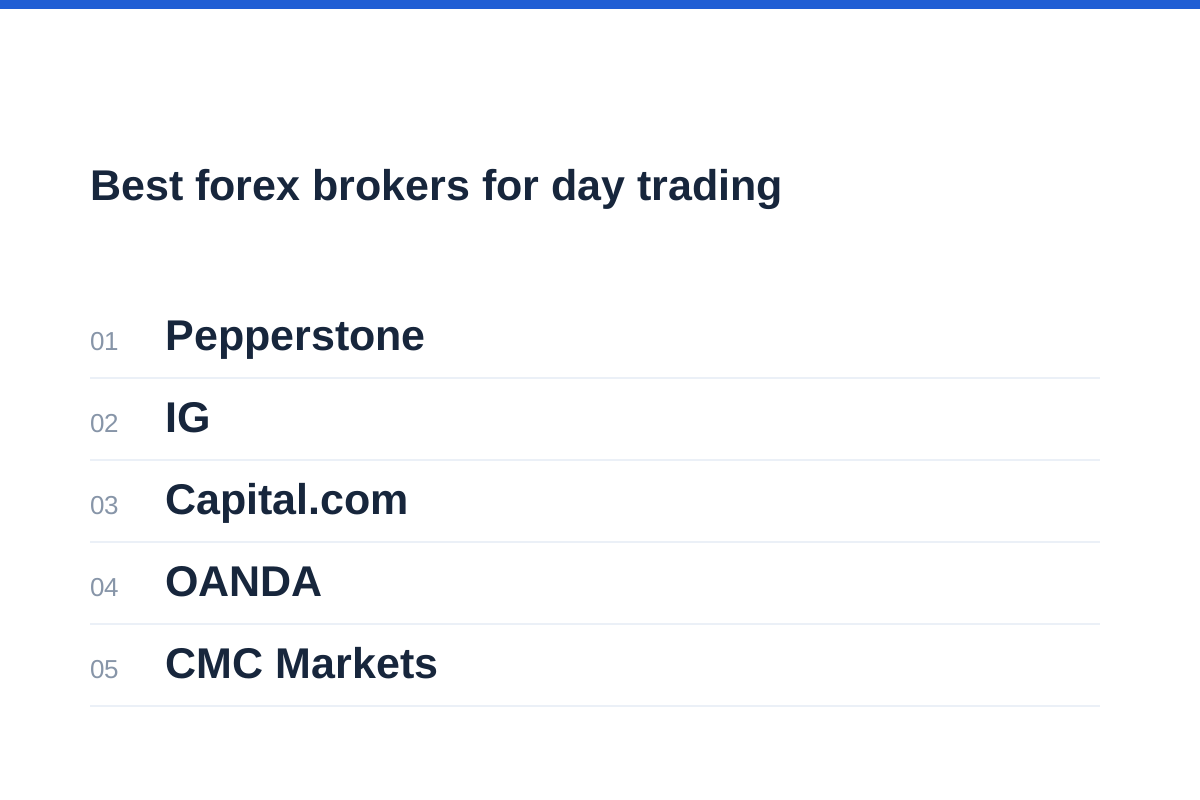
In briefChoosing the best forex brokers for day trading requires comparing total dealing costs and order controls at the same position size. Pepperstone is worth considering for its choice of spread-only and commission-based FX CFD pricing; IG for its dealing-ticket controls and demo workflow; Capital.com for mobile management and platform choice; and OANDA for eligible EU clients who want TradingView access. These are feature-based choices, not an execution-quality or cheapest-broker ranking. CMC Markets is also compared below, but is not recommended here because its platform information does not establish enough detail for an intraday assessment. Your contracting entity, actual costs and order requirements should determine the final choice.
Best forex brokers for day trading: the shortlist
Four brokers make this shortlist for different intraday needs. Pepperstone combines a choice of FX CFD pricing models with several platform options. IG describes detailed order controls and provides a demo for rehearsing its dealing workflow. Capital.com combines mobile position management with third-party platforms and demo access. OANDA offers TradingView integration for eligible EU CFD accounts, but not a TradingView demo. The fifth broker compared, CMC Markets, is not included in the recommendations: its UK platform page alone does not establish the costs and order controls needed for this assessment.
These are retail leveraged-trading candidates, not a comparison of deliverable spot currency accounts, exchange-traded currency futures or institutional FX execution services. Pepperstone explicitly describes CFD accounts; the other product and platform references below must also be read in their regional context. Buying currency for delivery is materially different from taking leveraged exposure to its price.
The order starts with pricing-model choice, then order management, platform flexibility and a more regionally restricted integration. It is not a score for execution speed, reliability or profitability, and it does not reflect live-account testing, measured fills, deposits or withdrawals. A broker lower down may better suit your particular workflow. None can make an unprofitable trading approach profitable. Leveraged forex trading can produce rapid losses and is not suitable for everyone.
| Broker and fit | Reason to consider | Principal trade-off |
|---|---|---|
| 1. Pepperstone — pricing-model choice | Standard and Razor offer distinct FX CFD pricing structures; TradingView is listed for Razor. | Compare commission plus actual spreads, not raw spreads alone. |
| 2. IG — order management and rehearsal | Dealing-ticket stops, limits, expiry and instrument specifications; web and MT4 demos. | Demo trades omit slippage and some live rejection and margin-close-out behaviour. |
| 3. Capital.com — mobile and platform flexibility | Mobile position management, demo access and MT4, MT5 and TradingView options. | Platform eligibility varies; conversion and triggered guaranteed-stop fees can add to costs. |
| 4. OANDA — eligible EU TradingView users | Eligible OANDA TMS Brokers CFD accounts can connect to TradingView. | EU integration is restricted to eligible EU clients and excludes demos. |
| CMC Markets — compared, not shortlisted | The UK platform page references web functionality on mobile. | That description alone is insufficient to recommend its intraday costs or order controls. |
What matters more than a headline spread
A useful comparison starts with the same currency pair, base-currency exposure, account currency and trading window. Comparing one broker’s smallest advertised spread with another’s typical spread is not meaningful. Nor is comparing equal margin deposits when the underlying exposures differ.
Prioritise total round-trip cash cost, workable order controls, platform continuity and funding arrangements. Frequency magnifies small charges, but reducing charges is not a reason to increase turnover. The FCA specifically identifies harm where customers are encouraged to trade more frequently or in larger volumes than suits their interests.
There are important limits to this comparison. It does not include a synchronised spread sample, independently measured slippage or comparable withdrawal timings. Published platform features establish what to investigate, not how well an account will perform during your trading session. Currency futures and institutional venues are excluded because their contracts, access requirements and cost structures need a separate comparison.
Before comparing features, establish the legal company behind the account. Our guide to checking whether a forex broker is regulated explains why a familiar trading name is not enough.
Pepperstone and IG: pricing choice versus order controls
Pepperstone’s Standard account incorporates FX trading fees into the spread, apart from overnight funding. Razor uses raw spreads plus commission for FX CFDs. Both list Pepperstone’s platform and app, MT4, MT5 and cTrader; the account comparison lists TradingView for Razor, not Standard. The choice therefore involves both pricing and interface. Compare the accounts using your intended currency pair, position size and trading session rather than assuming the commission-based account is cheaper.
The trade-off is that a raw spread is only one component of the bill. Platform, account currency and charging conventions can affect the cash amount. Pepperstone also states that MT4 commission is calculated for both sides upfront and charged when the trade opens. A statement can therefore look different from a simple per-side estimate.
IG’s international platform page documents a dealing ticket showing spread and margin, stops and limits including guaranteed stops, order expiry, and access to minimum sizes and stop distances. Those details are relevant when a trader needs to enter, amend and close positions without searching through separate menus.
IG’s order controls make it relevant when managing entry, amendment and exit is the priority. Its international site also lists MT5 and TradingView, while its UK MT4 page supports forex CFDs and spread betting, with trade sizes from 0.01 lots. These regional offerings are not interchangeable. The UK MT4 page quotes a minimum EUR/USD spread of 0.6 pips, not a typical dealing cost. Check guaranteed-stop availability, premiums and triggering rules for the actual instrument and platform; do not assume the web ticket’s features transfer unchanged to MetaTrader. Advertised DMA capability does not establish that every retail FX trade accesses an exchange order book.
Use the Pepperstone review to investigate the account structure further, then verify the current regional tariff before choosing Standard or Razor.
For the distinction between entry orders and exit instructions, read our forex order-types guide. A familiar button name does not guarantee identical handling across platforms.
Capital.com and OANDA: platform flexibility versus regional limits
Capital.com describes mobile position monitoring and trade management, with web, MT4, MT5 and TradingView alternatives. Its demo offers virtual funds without an expiry, but the provider explicitly says execution and liquidity may differ from live trading. MT4 supports live and demo CFD accounts under the licences listed on its platform page, with France excluded from that integration. MT5 supports live and demo accounts subject to region and account type. TradingView permits chart-based dealing where available; neither that connection nor a shared brand name establishes identical order functionality across platforms.
OANDA’s EU TradingView documentation describes connecting an eligible CFD account to trade through TradingView. This can reduce switching between charting and dealing interfaces. However, the EU help page says demo access is limited to MT5 and the OANDA app, with no TradingView demo access. Do not fund an account merely to resolve an unanswered interface question.
Regional distinctions are decisive. OANDA Global Markets’ BVI help page separately states that its demo accounts cannot use TradingView and that API functionality is unavailable for its clients. These are not universal statements about every OANDA entity, nor should another region’s advertised integration be assumed available.
Capital.com’s published international tariff lists no trading commission and dynamic spreads. It also lists a 0.7% retail currency-conversion mark-up and a guaranteed-stop fee payable when triggered, with the amount displayed on the ticket. These charges matter even for an intraday position, so check the regional tariff rather than treating commission-free trading as cost-free. Capital.com excludes numerous countries, including the UK’s neighbouring market Belgium, as well as Canada and the United States; it also says it cannot serve US citizens wherever they live. Residence and citizenship eligibility should be checked before spending time configuring a platform.
CMC Markets is the fifth brand compared, but not a fifth recommendation. Its UK platform page refers to carrying web functionality into mobile trading without establishing enough specific order behaviour or pricing for this comparison. That is not evidence that the broker lacks useful tools; it means there is no sound basis here for ranking it alongside the four shortlisted choices. Before considering it, establish the applicable tariff, platform specifications and contracting entity.
The OANDA review is a starting point for separating regional offerings; the application documents should identify the entity that would actually hold your account.
Compare cash cost at equal position size
For a position opened and closed without crossing a funding cut-off, estimate spread cost plus both sides of commission, then reconcile the result with actual fills. Add currency conversion and other applicable charges separately. Do not count the spread twice: with unchanged quotes, crossing the bid–ask spread on a round trip costs one full spread.
Consider an illustrative EUR/USD trade of 100,000 euros in a USD account. One pip is approximately $10. Assume the market’s mid-price does not move between entry and exit, and exclude financing and conversion. The invented prices below show why the narrowest displayed spread need not produce the smallest cash cost.
Account B saves only $1 against Account A before slippage. An additional 0.2 pip of total adverse execution difference would cost $2 at this size and reverse the result. This is a sensitivity calculation, not a forecast of either account’s execution.
Convert your own assumptions with the spread-cost calculator, keeping the pair, size and account currency consistent across candidates.
If the pip value is unclear, use the pip-value calculator before comparing a cash commission with a spread quoted in pips.
Turn a quoted spread into money
Excludes slippage, conversion, financing and other applicable charges.
| Illustrative account | Spread | Round-trip commission | Estimated round-trip cost |
|---|---|---|---|
| A: spread-only | 1.0 pip = $10 | $0 | $10 |
| B: raw plus commission | 0.2 pip = $2 | $7 | $9 |
| C: wider commission account | 0.5 pip = $5 | $7 | $12 |
Test news spreads and the full order lifecycle
A quiet-session spread says little about conditions around a rate decision or employment release. Quotes can widen and prices can move between order submission and execution. Record the event, time, spread, requested size and resulting fill rather than treating a single screenshot as representative.
An ordinary stop is not a guaranteed execution price. A limit order constrains price but may remain unfilled. Check partial fills, minimum stop distances, order expiry and whether linked exits remain active after one instruction executes. Technical indicators can organise a plan; they do not predict the next price.
Use a demo to learn the workflow, not to validate live execution quality. IG offers a web-platform demo and an MT4 demo, making it an option for rehearsing tickets and monitoring positions. Its international demo page says simulated trades are not subject to slippage, are not rejected on size or price grounds and do not reproduce live margin-related closures. Capital.com also warns that demo execution and liquidity may differ. Confirm whether protective orders are server-held and whether trailing logic needs a running terminal. If the documentation is unclear, ask support in writing before relying on the feature.
Check the position from entry to closure
Confirm size units, stop distance and the selected account.
Check the ticket and verify acceptance rather than assuming a click succeeded.
Practise changing size or exits and checking the resulting instructions.
Confirm the position is flat and remove any unintended pending orders.
Build redundancy without adding unnecessary exposure
Funding redundancy means understanding approved deposit routes, bank cut-offs and withdrawal verification before a disruption. It does not mean depending on an instant top-up to rescue a leveraged position. Check whether withdrawals must return to the original funding source and allow time for compliance checks.
Operational backup is separate. Keep official support details accessible, secure account recovery methods and a second internet connection where practical. A mobile app may help during a desktop fault, but it cannot overcome a broker-wide outage. Do not assume a second broker account can close a position held at the first.
Choose two candidates, verify the entity and tariff, rehearse the order workflow and set a maximum acceptable total cost for your intended trade size. If terms remain unclear, pause the selection. The practical objective is a controllable process, not the longest platform feature list.
Frequently asked questions
Which broker is best overall for intraday forex?
There is no universal winner. Pepperstone is relevant for comparing pricing models, IG for order controls and demo rehearsal, Capital.com for mobile and third-party platform options, and OANDA for eligible EU TradingView users. These are feature-based distinctions, not measured execution rankings. Compare actual cash costs and confirm regional eligibility before choosing.
Is a raw-spread account always cheaper?
No. Add opening and closing commission to spread cost at equal exposure. Check minimum charges, rounding and currency conversion. A spread-only account can be cheaper for a particular pair, size or session, even if its displayed spread is wider.
Does closing before midnight avoid financing?
Not necessarily. Financing follows the provider’s instrument-specific cut-off, not your local midnight. Check the server time, relevant timezone and daylight-saving treatment. An intended day trade can incur funding if it remains open across that cut-off.
Can I test OANDA TradingView on a demo?
Not through the EU integration described here: OANDA TMS Brokers limits that TradingView service to eligible clients in the EU and excludes demos. Its EU demo supports MT5 and the OANDA app instead. OANDA Global Markets in the BVI also excludes TradingView demo access. If demo rehearsal is essential, IG offers web and MT4 demos, while Capital.com offers demos with platform and regional conditions. None establishes live fill quality.
What protection matters most when choosing an account?
Start with the contracting entity and applicable retail rules, including leverage restrictions, margin close-out and negative balance protection where required. These protections do not prevent trading losses. The FCA warns that moving to an overseas entity or professional status can remove protections.