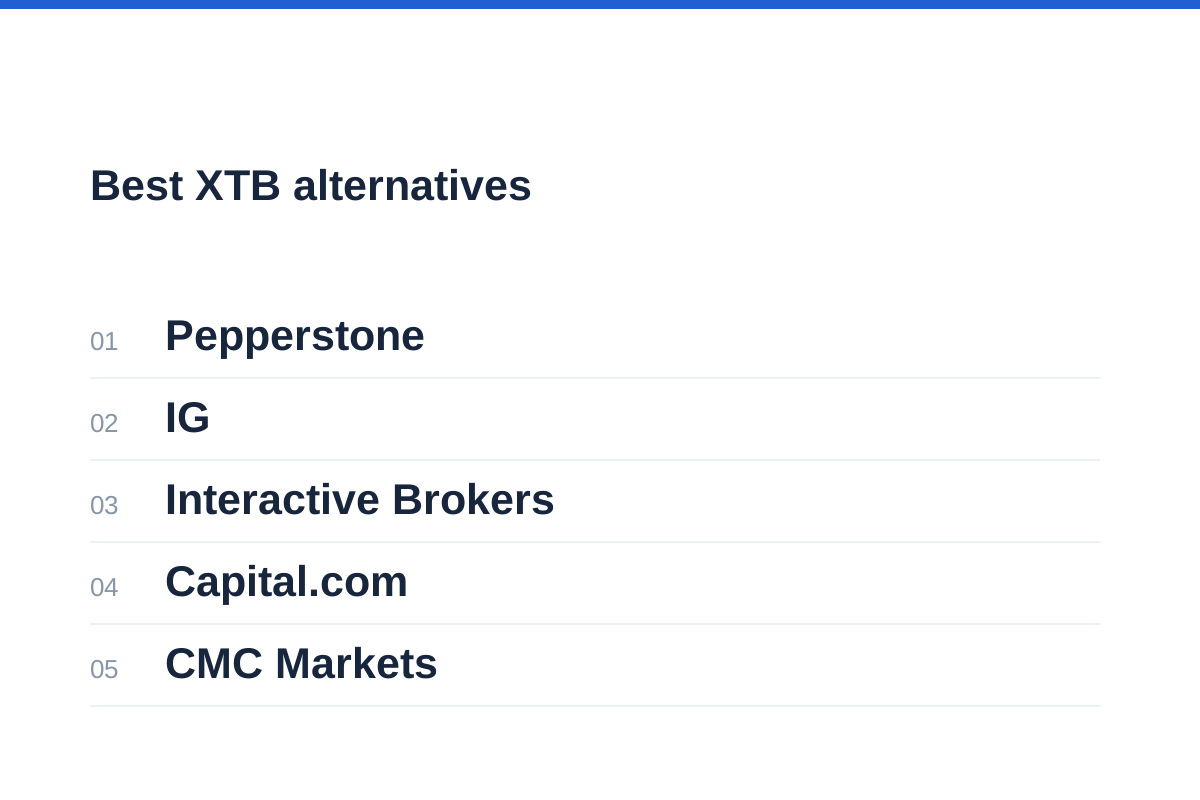
In briefThe best XTB alternatives solve a specific limitation in your current platform, product access or account terms rather than simply offering another brand. Choose an XTB alternative around the capability you need: Pepperstone for account-specific third-party platform choice, IG for chart connections and automated trading, Interactive Brokers for multi-asset access, Capital.com for native apps alongside third-party platforms, or CMC Markets for a web-and-mobile comparison. None is automatically better than XTB, and total costs depend on your trades and holding period.
Best XTB alternatives: shortlist and trade-offs
Compare Pepperstone if account-specific platform choice matters, IG for chart connections and automation, and Interactive Brokers for managing several asset classes together. Capital.com combines a native app with third-party connections, while CMC Markets offers a web-and-mobile proposition. These are different reasons to compare brokers, not a performance league table.
This shortlist compares published product features, not results from live-account testing. The sequence moves from third-party platforms and chart connections to broader asset access and native interfaces. It does not rank returns, financial strength or execution quality. Platform and product availability must still be checked against the legal entity accepting your application.
Start with the problem rather than the brand. Wanting an existing trading script to run, wanting to place orders from a chart, and wanting to own securities alongside currency exposure are different requirements. A broker that addresses one may introduce unnecessary complexity elsewhere.
| Broker | Reason to compare | Main qualification |
|---|---|---|
| Pepperstone | MT4, MT5 and cTrader across Standard and Razor | TradingView is listed for Razor, not Standard |
| IG | Chart connections and automated trading platforms | UK MT4 access is documented; check local eligibility for other connections |
| Interactive Brokers | Equities, options, futures, forex, bonds and funds | Access depends on entity, permissions and platform |
| Capital.com | Native app, TradingView, MT4 and MT5 | Regional and account restrictions apply; distinguish CFDs from owned securities |
| CMC Markets | Web-platform functionality in a mobile format | Check the exact local platform tools and instrument specifications |
Pepperstone: a clear starting point for third-party platforms
Pepperstone is worth comparing if your reason for leaving is a specific platform requirement. Its account comparison names MT4, MT5 and cTrader for both Standard and Razor, alongside its own web platform and mobile app. TradingView is explicitly listed for Razor rather than Standard.
That distinction matters more than a general claim that a broker supports TradingView. Choosing an account first and checking integration later can leave you with the wrong charging structure or an unusable workflow. Confirm that your intended instruments and account entity support the connection.
The pricing trade-off is also explicit: Standard uses spread-based FX pricing, while Razor uses raw spreads plus commission for FX. Neither structure is inherently cheaper for your trading. Compare the spread actually available during your trading session, commission on both sides and overnight funding.
For automated strategies, test more than whether the software launches. Check symbol names, contract sizes, minimum order increments and stop-order behaviour. A script designed around another broker's specifications may need changes even when the platform name is identical.
Use our Pepperstone review to explore the broker in more detail, then verify the account-platform combination on the relevant local website.
IG: compare chart connections and specialist workflows
IG describes web and mobile trading alongside TradingView, MT4, MT5, ProRealTime and L2 Dealer on its international platform page. TradingView supports orders directly from charts, while its MetaTrader and ProRealTime descriptions include automated trading. IG's UK MT4 page separately confirms access to forex, indices and commodities through CFDs or spread betting, with Expert Advisors available for automation.
This makes IG worth investigating when your switching reason concerns workflow rather than simply finding another dealing app. A chart-led discretionary trader and someone developing automated strategies may need different platforms within the same broker.
Availability is geographical and product-specific. UK MT4 access does not establish UK eligibility for every connection on IG's international website. Its international MT5 page describes Expert Advisors and advanced charting, but applicants should confirm local account access. Likewise, L2 Dealer's direct-market-access description does not mean every retail FX order goes directly to an exchange or institutional order book.
Check what survives a connection change: saved layouts, alerts, custom indicators and order management may behave differently across interfaces. Charting tools can organise analysis; they cannot establish what a currency pair will do next.
Our IG review provides a broader comparison context; local platform eligibility remains a separate check before applying.
Interactive Brokers: consider it for genuinely different market access
Interactive Brokers is the most distinct alternative here. Its Trader Workstation documentation lists equities, options, futures, forex, bonds and funds in one platform, with portfolio-level exposure and margin monitoring. That is a different proposition from adding more underlying markets to a CFD account.
It deserves attention if your objective is to manage investments and currency exposure together, or investigate exchange-traded currency futures. However, a platform's product list does not mean every applicant receives every permission. Establish which products your entity offers and which your account can access.
Distinguish a currency conversion used to fund an investment from a leveraged currency position. Then distinguish both from a futures contract, which has its own expiry, contract size and margin arrangements. Comparing only the currency-pair name misses the legal and operational differences.
Choose the interface as carefully as the asset range. TWS offers advanced order management, portfolio risk analysis and margin monitoring, but it is not Interactive Brokers' only platform. IBKR Desktop also lists stocks, options, futures, currencies, bonds and funds, with a different layout and workflow. Client Portal and mobile platforms provide further options. Confirm product support in your chosen interface, then practise placing and cancelling the exact order types you intend to use.
Read our Interactive Brokers review if broader asset access is the reason for your move, rather than treating it as a like-for-like CFD replacement.
Capital.com and CMC Markets: native interfaces and connected workflows
Capital.com's native app supports position monitoring and trade management across CFD markets including shares, indices, forex and commodities. It also offers TradingView chart trading, MT4 and MT5. That makes it relevant to traders who want to compare a native interface without ruling out third-party software. A connection's availability still depends on the region and account.
Its MT4 documentation confirms Expert Advisors and live or demo CFD access under several regulatory licences, including the FCA and CySEC, but excludes residents of France from that integration. MT5 supports custom indicators and automated strategies, with availability depending on region and account type. Capital.com's demo page cautions that execution and liquidity may differ from live trading. Use it to rehearse tasks, not to establish execution quality.
Keep the product distinction clear. Capital.com's CFD market range does not represent ownership of those underlying assets. Its EU website separately advertises owned stocks and ETFs, alongside CFDs and knock-outs; that does not establish equivalent access elsewhere. Check country eligibility and the contracting entity before comparing either the investment range or the available platforms.
CMC Markets is relevant to a different switching question: whether a web-and-mobile interface suits your routine. Its platform page describes bringing web-platform functionality to mobile. Compare the tasks that matter to you, such as locating contract specifications, adjusting orders and reviewing exposure. This is not a claim of superior usability, automation or integrations, and a preference for the interface does not establish lower trading costs.
Financing deserves a separate check. Capital.com's international fee schedule lists dynamic spreads, no trading commission and overnight adjustments that may be paid or received. It also lists conversion charges and a premium when a guaranteed stop is triggered. Most unleveraged CFD positions are exempt from overnight funding, with specified exceptions. Confirm the schedule for your entity and instrument rather than applying those terms universally. For CMC Markets, check the corresponding local funding terms before making a holding-cost comparison.
Our Capital.com review is the next comparison point if a dedicated CFD app is your priority.
Use the CMC Markets review to explore the broker further, then compare its local contract specifications with the tasks and instruments you need.
Test the task that prompted your move
Write down one missing capability, such as chart-based orders or clearer funding information.
Confirm the local entity, account and instrument support it.
Practise opening, amending and closing an order in the intended interface.
Compare total costs, not the smallest advertised spread
A financing-led switch requires more information than a platform-led one. Collect the same pair, position size, account currency, direction and holding period for each candidate. Minimum spreads and a generic commission headline cannot produce a reliable cost ranking.
Build a like-for-like calculation using the broker's applicable terms rather than hypothetical prices. For EUR/USD, a position of 10,000 euros has a pip value of $1 when a pip is 0.0001 dollars per euro. Multiply the spread in pips by that pip value, then add the opening and closing commission. If the opening and closing spreads differ, using half of each spread gives a more precise estimate than assuming a single spread throughout.
Next, add the funding adjustments for the actual holding period, treating a credit as a reduction in cost. Check which nights are chargeable and whether any rollover includes several days. Include applicable conversion charges and other trade-specific fees separately. A smaller spread need not produce a lower total cost once funding is included. This calculation can narrow a shortlist, but it cannot predict slippage or guarantee the price available when you submit an order.
Use the spread-cost calculator to translate pip differences into money for your position size.
Then use the swap-cost calculator with the broker's applicable funding inputs, checking rollover conventions separately.
Add transaction costs and funding
For a US-dollar account, multiply this pip value by the applicable spread in pips. This is a unit calculation, not a broker price quotation.
| Cost component | What to collect | Common comparison error |
|---|---|---|
| Spread | Typical executable spread during your trading hours | Treating a minimum as consistently available |
| Commission | Both sides, correct size and account currency | Comparing one side with a round-trip figure |
| Overnight funding | Long or short charge and charging calendar | Multiplying a headline rate without checking conventions |
| Currency conversion | When conversion occurs and the applicable charge | Ignoring a mismatch with the account currency |
| Execution difference | Requested versus filled price on comparable orders | Assuming a demo proves live execution quality |
Check the entity and avoid switching for an unverified promise
Before funding an alternative, identify the contracting company in its terms and verify its permissions with the relevant regulator. A familiar brand name does not establish which legal entity holds your account or which protections apply.
The FCA treats CFDs, including rolling spot FX, as high-risk products unsuitable for some retail consumers. UK retail protections should not be assumed to follow you to an overseas affiliate or a professional classification. Leverage increases exposure; it is not a reason by itself to move.
There is no need to switch simply because another broker offers more platforms or markets. Check whether XTB already supports the capability you need for your account and region. Moving also means learning new contract specifications, account controls and funding arrangements. An additional platform is useful only if it solves a practical problem; an expanded product range can add complexity without improving your trading decisions.
Finish with a written decision: the capability gained, the cost assumptions and the remaining uncertainty. Export records before closing an old account. Existing OTC positions should not be assumed transferable; ask about closure, funding and withdrawal procedures before initiating the move.
Follow our guide to checking whether a forex broker is regulated and match the register entry to the company named in your agreement.
Frequently asked questions
Which XTB alternative should I compare first?
Start with your switching reason: Pepperstone for account-specific third-party platform choice, IG for chart connections and automation, or Interactive Brokers for several asset classes in one account. Capital.com and CMC Markets are also relevant when comparing native interfaces. None is the right first choice for every trader.
Which alternative supports TradingView?
Pepperstone lists TradingView for Razor rather than Standard. IG's international website describes TradingView connectivity, and Capital.com documents placing trades directly from TradingView charts. Confirm regional eligibility, instruments and account compatibility before applying; a broker-level integration is not a universal account entitlement.
Is any alternative definitely cheaper than XTB?
No universal cost advantage is established here. Compare executable spreads, round-trip commissions, funding and conversion charges for the same trades. A no-commission account still has trading costs, and holding period can reverse an apparent spread advantage.
Can I use a demo to choose a replacement?
Yes, for learning order entry and rehearsing routine tasks. IG offers a platform demo and a separate MT4 demo; its demo terms describe differences including no slippage and different rejection and margin-close-out behaviour. Capital.com also offers demo access, including eligible MT4 and MT5 accounts, but warns that execution and liquidity may differ from live trading. Confirm the intended interface and instruments before testing.
Do these brokers all offer the same kind of forex trading?
No. Check whether the account provides CFDs, rolling spot FX, deliverable currency transactions or currency futures. Interactive Brokers' broader product range particularly requires this distinction. Contract terms, permissions, margin and settlement can differ substantially.